

Affection can feel different over the course of a relationship. You might miss easy conversation, warmth or time together. That change does not have a single explanation, and it does not mean one person can restore the relationship through effort alone.
If you both want to explore reconnection and feel safe doing so, begin with a clear conversation about what is happening. These seven steps offer possibilities, with room for each person’s wishes and limits.
On this page
- Describe what has changed
- Ask whether you both want to work on connection
- Use respectful language without overlooking real problems
- Choose manageable time together
- Keep affection and sexual contact voluntary
- Leave room for individual lives and support
- Review what is changing and what remains unresolved
1. Describe what has changed
Be specific about what you miss: talking beyond household tasks, being greeted warmly or making time for something enjoyable. Consider when you began noticing the distance and what else changed around that time.
“We rarely spend time together without another task” is easier to discuss than deciding that the other person no longer cares. You can name the effect on you without claiming to know their motives.
2. Ask whether you both want to work on connection
A relationship cannot be repaired through one person’s kindness or optimism alone. Ask what each of you wants and what you are willing to try. The answers may be uncertain or different.
Make room for an honest response. Someone agreeing out of guilt is not the same as sharing the goal. You do not have to promise to stay together before having a conversation about the relationship.
3. Use respectful language without overlooking real problems
Choose a concrete request and avoid insults, threats or a list of personal flaws. Listening may help you understand each other, but respect does not require dismissing dishonesty, neglect or a repeated broken agreement.
If a conversation becomes heated and you both feel safe, consider a pause with an agreed time to return. If you fear punishment for raising concerns, seek individual support rather than making a difficult conversation another obligation.

4. Choose manageable time together
A shared activity can be small: a walk where accessible, a meal, music or a short conversation. Discuss what each person would enjoy and what fits the money, energy and care responsibilities available.
A new activity can offer something to share, but it does not guarantee a renewed spark. Notice whether the experience makes room for interest and care rather than treating it as a test you must pass.
5. Keep affection and sexual contact voluntary
Ask what kinds of closeness each person currently wants. Conversation, companionship or holding hands may feel welcome; a particular kind of touch may not. Neither person owes physical contact to prove love or protect the relationship.
RAINN’s consent guidance emphasises voluntary, ongoing agreement for sexual activity. Respect a change of mind. If pain or another health concern is affecting intimacy, the person experiencing it can seek appropriate healthcare without pressure to resume sex.
6. Leave room for individual lives and support
Friendships, interests, rest and time alone can remain important while you work on connection. You do not need to become a previous version of yourself or give up your own needs to be a caring partner.
When both people feel safe and want help, an appropriately qualified relationship counsellor may support a conversation. If there is intimidation or abuse, consider confidential individual support and safety planning first.
7. Review what is changing and what remains unresolved
Agree on a time to discuss how your efforts are going. Look at everyday behavior: listening, reliability, respected boundaries and shared responsibility. An affectionate moment can matter without settling every issue.
You may decide to keep trying, seek support, take space or end the relationship. Reconnection is an exploration that needs mutual participation; it is not a result you can guarantee by following a checklist.
When one person misses a familiar greeting
If you miss the hug you used to share when you came home, ask how your partner feels about greetings now. They may prefer a few quiet minutes first, a verbal hello or time together later.
Choose one form of connection that works for both of you and ask whether it feels good after trying it. Either person can suggest a different form of affection when their needs change.
Read the infographic in text
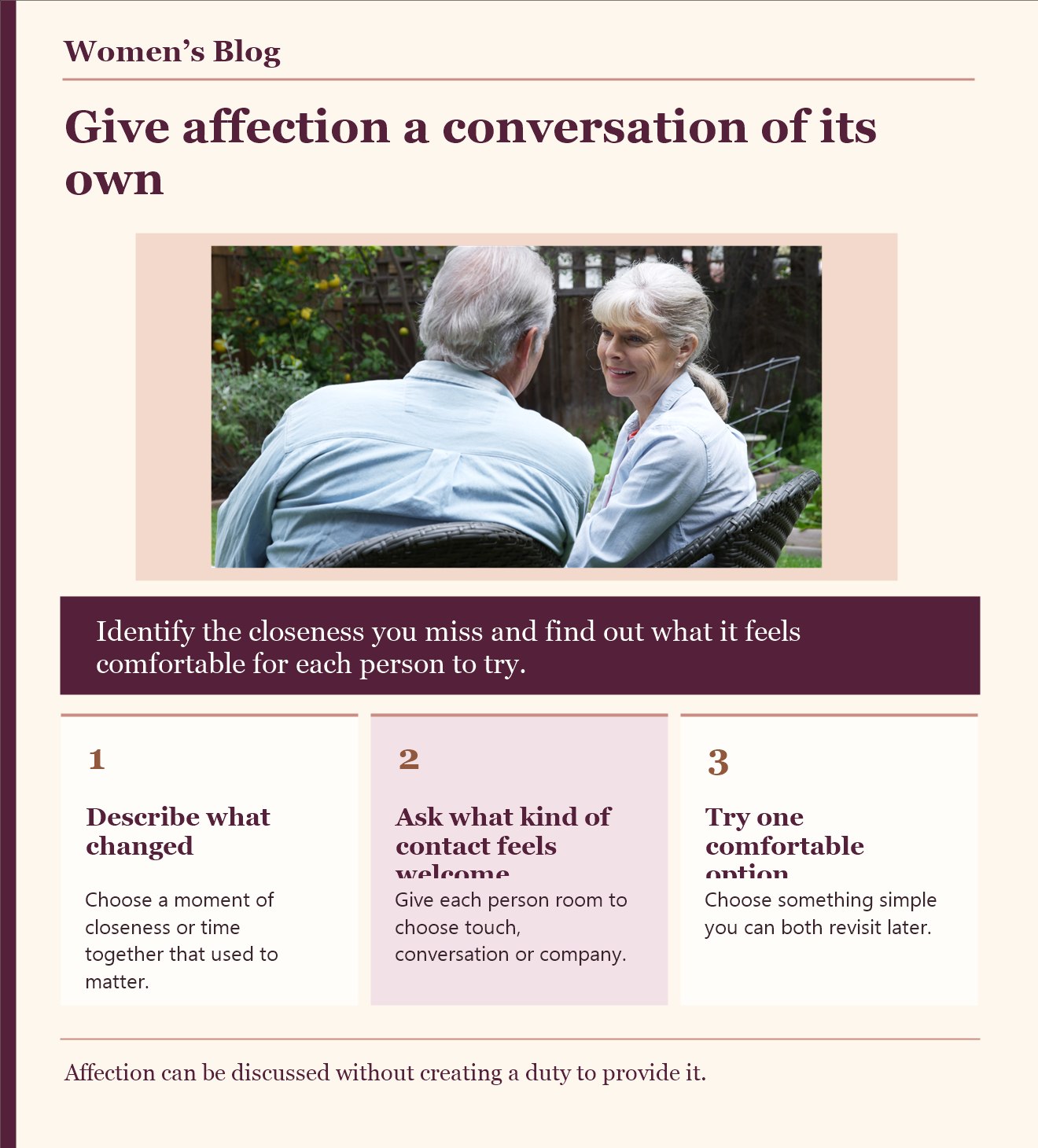
Give affection a conversation of its own
Identify the closeness you miss and find out what it feels comfortable for each person to try.
- Describe what changed Choose a moment of closeness or time together that used to matter.
- Ask what kind of contact feels welcome Give each person room to choose touch, conversation or company.
- Try one comfortable option Choose something simple you can both revisit later.
Affection can be discussed without creating a duty to provide it.