

It can be disappointing to spend time visualising, journaling or repeating affirmations and still see little change in the situation you care about. You may start wondering whether you are doing something wrong, wanting too much or somehow preventing the outcome.
A result that has not arrived is not evidence that your feelings are defective. If manifestation has spiritual meaning for you, you can keep that meaning while reviewing the practical situation. You do not have to deny disappointment, wait indefinitely or make every decision depend on a sign.
On this page
Check whose goal you are pursuing
Ask what you would still want if nobody else could judge the outcome. A relationship, promotion or move may matter to you for good reasons. It may also carry pressure from family, friends or an image of where you think you should be by now.
Describe the need underneath the goal. If you want a relationship, are you hoping for companionship, shared parenting, commitment or reassurance? Naming those differences can help you make choices that fit, rather than accepting any connection as proof that your practice worked.
Your wishes can change. Revising a goal does not mean you failed to believe strongly enough. It may mean that experience has given you a clearer sense of what is welcome in your life.
Review what the practice is asking of you
Consider the time, attention and money involved. Does journaling help you clarify a choice, or have you begun to feel that missing a day will ruin your future? A meaningful practice can still need limits.
Try a smaller version if you want to continue. You might write one sentence about your intention and one about a practical step, then put the journal away. You do not need to monitor your mood all day or replace every doubtful thought before doing something useful.
Be cautious of repeated paid explanations for why an outcome has not happened. A promise that the next purchase will remove the final block is not evidence that the promise can be kept. You can stop spending without having to prove that your disappointment is justified.
Separate missing information from self-blame
Look at what has been tried and what remains unknown. If you want a job change, do you know the requirements and have you received any feedback? If you want a relationship, has the other person clearly said they want one too?
External circumstances matter. Availability, cost, discrimination, illness, caring responsibilities and another person’s choices can all affect what happens. None can be solved simply by declaring that you are aligned with the right energy.
Choose a question that could bring useful information: “What experience is required?” or “Are we looking for the same commitment?” A direct answer may be difficult to hear, but it gives you more to work with than trying to infer a hidden message from silence.
Give waiting a practical boundary
Sometimes waiting is unavoidable. You may be expecting a decision, saving money or allowing time for a change already underway. Identify what you are waiting for and when it would make sense to review the situation.
For example, you might follow up once after an agreed date or decide how long an uncertain arrangement remains workable for you. This is a boundary for your own participation, not a deadline intended to force someone else to choose you.
Keep the rest of your life in view. Friendships, rest, responsibilities and enjoyable activities do not need to be postponed until a hoped-for result arrives. You can want something deeply without making every day a waiting room for it.
Choose whether to continue, change or pause
Ask what continuing would involve and whether that still fits your needs. You might retain a spiritual practice, change the practical approach or take a break from both. There is no requirement to feel grateful for a setback or assume that something better is guaranteed.
If the process leaves you frightened, isolated or repeatedly blaming yourself, speak with someone who can help you look at the situation without selling a promised outcome. You can also seek appropriate professional support for distress that is affecting everyday life.
A useful next choice may be modest: request one piece of information, decline an expense or make room for another possibility. You are allowed to respond to life as it is while remaining open to what you hope for.
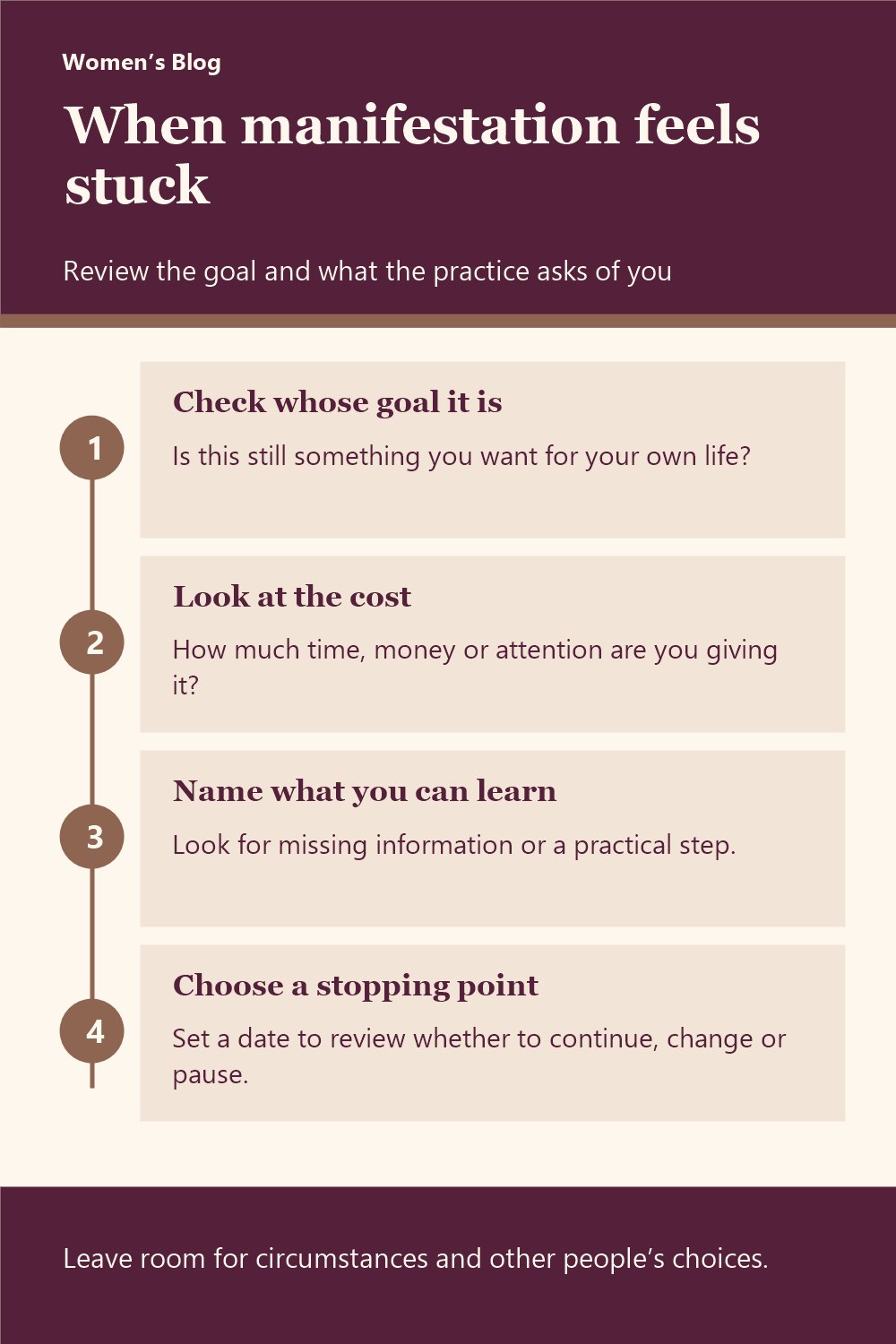
Read the infographic in text
When manifestation feels stuck
- Check whose goal it is Is this still something you want for your own life?
- Look at the cost How much time, money or attention are you giving it?
- Name what you can learn Look for missing information or a practical step.
- Choose a stopping point Set a date to review whether to continue, change or pause.
Leave room for circumstances and other people’s choices.