

People use “enlightenment” or “spiritual awakening” to describe different changes in how they understand themselves, their beliefs and their place in the world. The words may feel meaningful when you are questioning familiar expectations or noticing what matters to you. They do not need to describe a rank you have reached or a state everyone should pursue.
Rather than looking for a list that proves you are awakened, consider what is changing in your actual life. What feels helpful, what feels difficult and which choices remain yours? You can make room for spiritual meaning while keeping ordinary needs, relationships and support in view.
On this page
Let the meaning be personal
You do not need to compare yourself with a public figure, teacher or idealised version of a spiritual person. Someone’s public image cannot establish their inner experience, and another person’s description may not fit yours.
Start with a specific observation. Perhaps a habit no longer suits you, you want to spend time differently or a belief has become less certain. Ask what you would like to understand or change. These questions can be useful whether or not you call the experience an awakening.
Try keeping the language flexible: “I am reconsidering what success means to me” gives you something clearer to explore than deciding that every part of your former life was wrong. You can value what you have learned and still choose a different direction.
Stay connected without losing your choices
A growing interest in community, nature or service may matter to you. Choose involvement that fits your time, resources and capacity. Helping with one manageable task can be enough; you do not need to exhaust yourself to demonstrate compassion.
Your interests, dietary needs, relationships and everyday preferences do not have to disappear as you explore a new perspective. A medical food restriction, for example, is not an attachment you must overcome. Keep decisions connected to your circumstances rather than to a demand to become less “ego-driven.”
If a group or adviser asks you to give up trusted relationships, dismiss your concerns or rely on their approval for ordinary decisions, pause and seek an outside perspective. You are allowed to ask questions, set limits and leave a conversation or practice that does not feel right for you.
Make room for changing feelings
Curiosity, hope, anger, sadness and confusion can all be part of a period of change. Feeling upset does not disqualify you from reflection or mean you have failed to become peaceful. You can take a feeling seriously without letting it decide every action.
Intuition may be a useful word for a quick impression or sense that something deserves attention. Consider it alongside what you can observe, what others have actually said and the consequences of a decision. A strong feeling does not establish someone else’s motives or guarantee that a choice will work out.
For an important decision, make room for time and information where possible. You might write down the concern, discuss it with someone who respects your independence or ask a qualified adviser a specific question. You do not have to act immediately because a feeling seems spiritually significant.
Treat coincidences with curiosity
A repeated number, an unexpected meeting or a familiar phrase can catch your attention. You may enjoy giving it personal meaning. The event alone does not tell you what the future holds or what another person wants.
Try separating the event from the interpretation: “I noticed the same number twice” describes the observation; “I must contact my ex” adds a conclusion. You can appreciate the moment without treating that conclusion as an instruction. Existing boundaries and another person’s wishes still matter.
Keep compassion in the way you interpret your own experience too. There is no need to blame yourself for missing a sign or having a doubtful thought. If checking for signs becomes tiring or upsetting, you can step back and focus on something ordinary and manageable.
Allow questions, fear and uncertainty
Exploring spiritual beliefs does not require you to stop fearing death, loss or change. You may find comfort in a belief and still have unanswered questions. Your uncertainty is not a measure of how deeply you care or how far you have progressed.
If a topic feels overwhelming, choose the pace at which you engage with it. You might discuss it with a trusted person, take a break from reading or seek professional support if distress is affecting your daily life. You can also decide that a particular explanation does not fit.
Being honest with yourself can include keeping a private belief, changing your mind or saying, “I am not sure.” You do not have to make other people follow your interpretation, and you do not have to abandon your judgment to belong.
Keep everyday care in the picture
Feeling spiritually connected does not guarantee good health, success or effortless relationships. Daily circumstances still matter. Consider whether you have enough rest, regular meals, practical help and contact with people who treat you with care.
The National Institute of Mental Health’s guidance on caring for your mental health includes setting priorities, enjoyable activities and reaching out for support. If distress, poor sleep or difficulty with ordinary tasks persists, appropriate healthcare can be part of looking after yourself alongside your beliefs.
Choose a small, optional practice rather than a demanding programme: a short journal entry, a comfortable pause, a walk that suits your circumstances or a conversation about something important. Ask afterward whether it helped you understand a need or make a workable choice. You can adapt it, stop it or try something else without treating that decision as a spiritual failure.
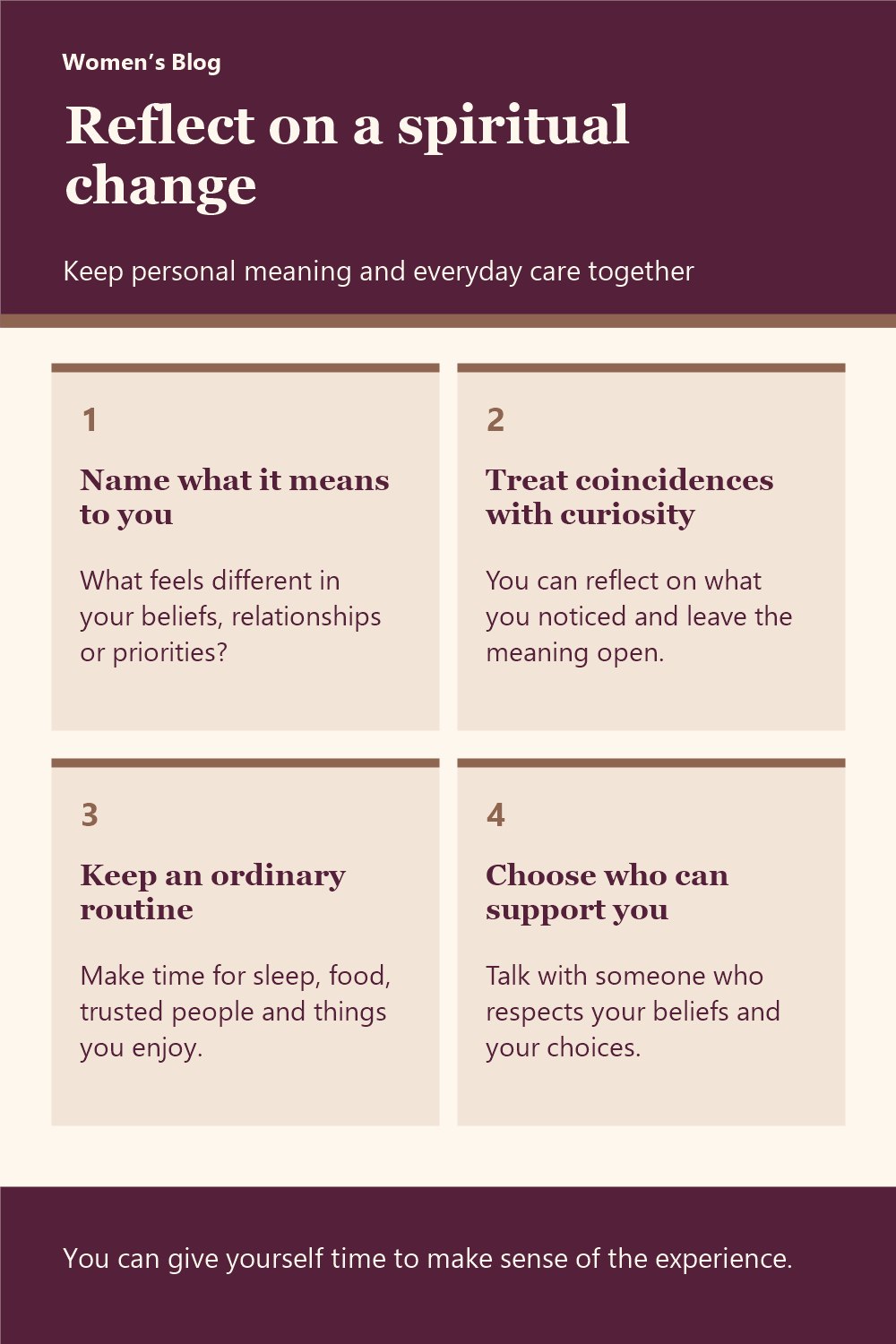
Read the infographic in text
Reflect on a spiritual change
- Name what it means to you What feels different in your beliefs, relationships or priorities?
- Treat coincidences with curiosity You can reflect on what you noticed and leave the meaning open.
- Keep an ordinary routine Make time for sleep, food, trusted people and things you enjoy.
- Choose who can support you Talk with someone who respects your beliefs and your choices.
You can give yourself time to make sense of the experience.