

“All is fair in love and war” can sound like permission to do whatever it takes to win someone over. A relationship involves people with their own choices, needs and limits. Strong feelings do not make deception, pressure or humiliation fair.
Fairness does not require identical needs or agreement on everything. It means taking each other seriously, discussing expectations and accepting that affection cannot be demanded. These seven choices offer a practical place to begin.
On this page
- Respect a clear and freely chosen yes
- Discuss expectations rather than relying on unwritten rules
- Be honest about information that affects a choice
- Keep privacy separate from secrecy used to deceive
- Handle disagreements without trying to punish
- Make repair visible in everyday behavior
- Accept that a fair outcome can include an ending
1. Respect a clear and freely chosen yes
Someone can like you and still decline a date, a conversation or physical intimacy. A previous yes does not remove their ability to say no now. Asking repeatedly, applying guilt or treating refusal as a challenge puts pressure on a choice.
For sexual activity, RAINN explains consent as a voluntary, ongoing agreement. Check that both people want what is happening and can change their mind without fear. A relationship label is never a substitute for consent.

2. Discuss expectations rather than relying on unwritten rules
People may attach different meanings to dating, exclusivity, flirting or contact with former partners. Say what you want and ask what the other person wants. If the answers differ, you can consider whether the relationship suits you.
For example: “I would like us to be exclusive. Is that something you want too?” An agreement should be mutual. Neither person owns the other’s future choices, and a friend does not own someone they used to date.
3. Be honest about information that affects a choice
Do not invent availability, intentions or commitments to keep someone interested. If your plans change, make room for a clear conversation. Honesty allows the other person to decide whether they still want to participate.
You can be truthful without sharing every private thought. “I do not want to continue dating” can be enough; giving false hope to avoid an uncomfortable answer can prolong uncertainty.
4. Keep privacy separate from secrecy used to deceive
Being close does not create an entitlement to passwords, constant location updates or access to someone’s messages. Discuss what you are comfortable sharing instead of using monitoring as proof of loyalty.
Also consider whose information is yours to share. Ask before posting a partner’s photograph or disclosing something personal. You may still seek confidential support about your own experiences, especially when you feel unsafe.
5. Handle disagreements without trying to punish
A disagreement is not a contest that one person must lose. Describe the specific problem and what you need. Avoid threats, insults, public embarrassment or deliberately provoking jealousy.
You do not have to resolve every argument before bedtime. If you both feel safe, agree on a pause and a realistic time to return: “I need a break. Could we talk tomorrow after dinner?” A pause should not be used to keep someone uncertain indefinitely.
6. Make repair visible in everyday behavior
An apology can acknowledge the action, its effect and what will change. Ask what repair is possible, while accepting that the other person may need time or may not want to continue the relationship.
Look for follow-through: a respected limit, a kept agreement or a different response during the next disagreement. Gifts or affectionate words do not erase a recurring pattern on their own.
7. Accept that a fair outcome can include an ending
Both people can act respectfully and still want different futures. Staying together is not the only measure of success. You are allowed to leave a relationship that does not work for you, and the other person has the same freedom.
If pressure, threats or control make it unsafe to disagree or leave, prioritise support suited to your circumstances. Fairness does not require giving unlimited chances or having a final conversation alone.
Read the infographic in text
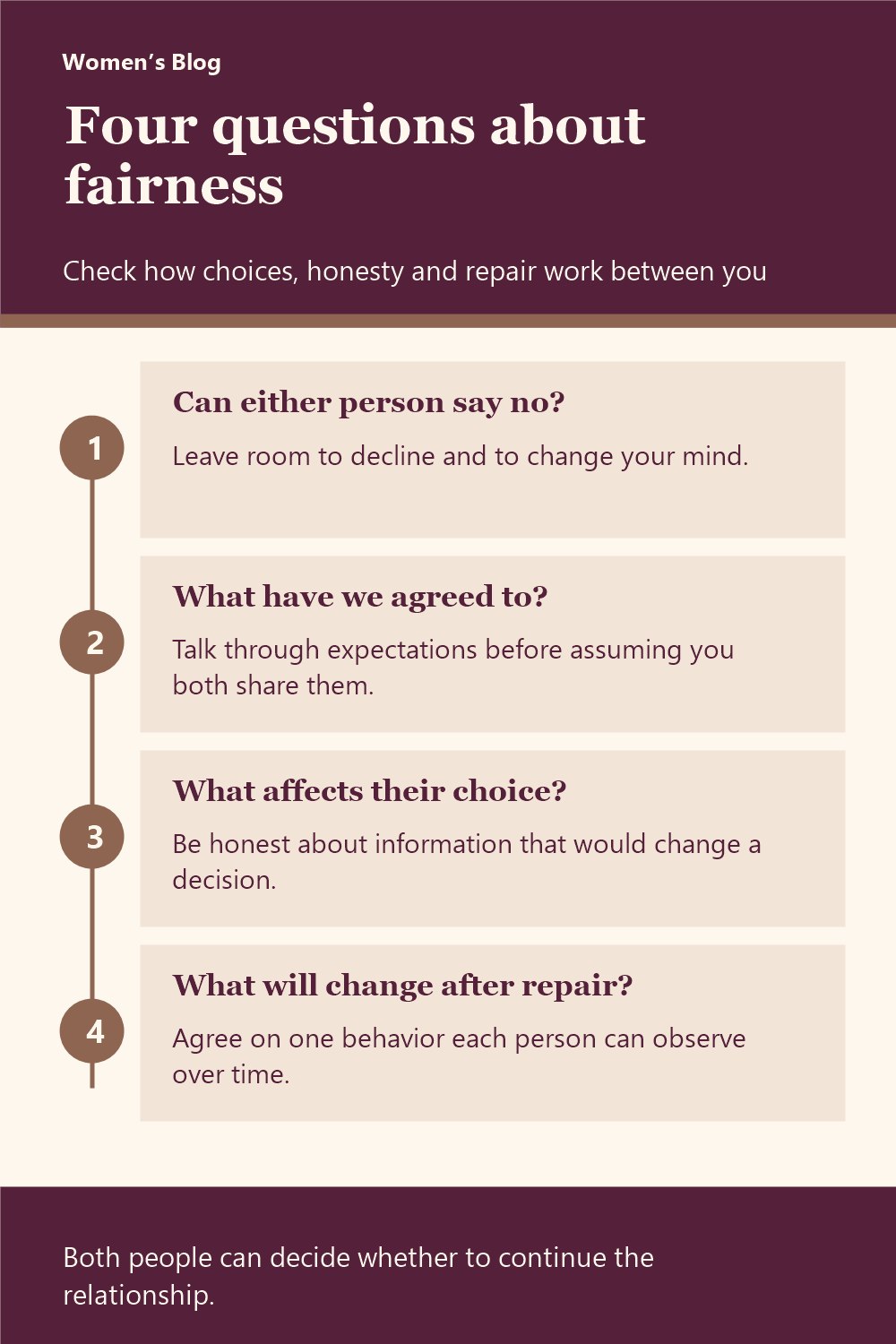
Four questions about fairness
- Can either person say no? Leave room to decline and to change your mind.
- What have we agreed to? Talk through expectations before assuming you both share them.
- What affects their choice? Be honest about information that would change a decision.
- What will change after repair? Agree on one behavior each person can observe over time.
Both people can decide whether to continue the relationship.