

You do not have to reach a perfect level of self-love before you deserve a caring relationship. Doubt, insecurity and a need for reassurance can be part of life. They do not make you responsible for a partner’s dishonesty, neglect or abuse.
Caring for yourself can help you recognise needs and make choices. A partner also has responsibility for how they behave. These ideas focus on practical communication and mutual respect, rather than treating self-love as the cause of every relationship problem.
On this page
1. Separate your worth from the relationship’s condition
A difficult relationship is not proof that you are unworthy or have failed to improve yourself. Ask what is happening between you: how decisions are made, how disagreements go and whether each person’s needs are considered.
You can work on confidence while also deciding that a specific behavior needs to change. Neither task requires you to accept blame for someone else’s choices.
2. Ask for reassurance in a specific way
It is reasonable to want comfort and care. Try naming what would help: “I am feeling uncertain after that conversation. Could you explain what you meant?” or “Do you have ten minutes to listen?” A clear request may be easier to respond to than expecting someone to guess.
Both people can discuss limits on time and energy respectfully. If the same worry keeps returning, consider what is unresolved and whether support outside the relationship would help. You do not have to become completely independent of other people’s care.
3. Take poor treatment seriously
No amount of self-love guarantees that another person will treat you well. Threats, humiliation, isolation, monitoring and pressure deserve attention regardless of how confident you feel.
If you are afraid of a partner’s reaction, consider confidential support from a domestic abuse service and a plan that fits your situation. The National Domestic Violence Hotline’s relationship guide describes healthy, unhealthy and abusive patterns. Responsibility for abusive behavior belongs to the person doing it.
4. Check a concern without automatically dismissing it
When something feels wrong, separate what you observed from what you fear it means. Ask a specific question when it is safe. Consider the answer alongside the person’s actions over time.
A concern can be mistaken, accurate or still unclear. Calling every negative interpretation insecurity can make it harder to recognise a real problem. You are allowed to take your observations seriously while remaining open to information.
5. Use comparison to identify a need
Another couple’s life gives you only partial information. Instead of deciding your relationship must look the same, ask what you are missing or hoping for: shared time, affection, reliability or a fairer division of tasks.
You do not need expensive gifts, a particular body size or a polished social media presence to show self-respect. A boundary, an honest request or making time for something meaningful may fit your needs better.

6. Keep room for both connection and independence
Consider how you want to maintain friendships, interests, rest and shared time. A caring partnership can include support and interdependence without giving one person control over the other.
If an agreement is not working, discuss a concrete adjustment. Notice whether both people can say no, change their mind and ask for help without punishment.
7. Choose one next step and review it
You might make a request, set a limit, speak with someone supportive or take time to think about the relationship. Choose a step that is realistic and safe for you.
Self-respect can grow through ordinary choices, even while you still have doubts. A relationship’s future depends on more than your efforts alone; consider whether care, accountability and willingness to change are mutual.
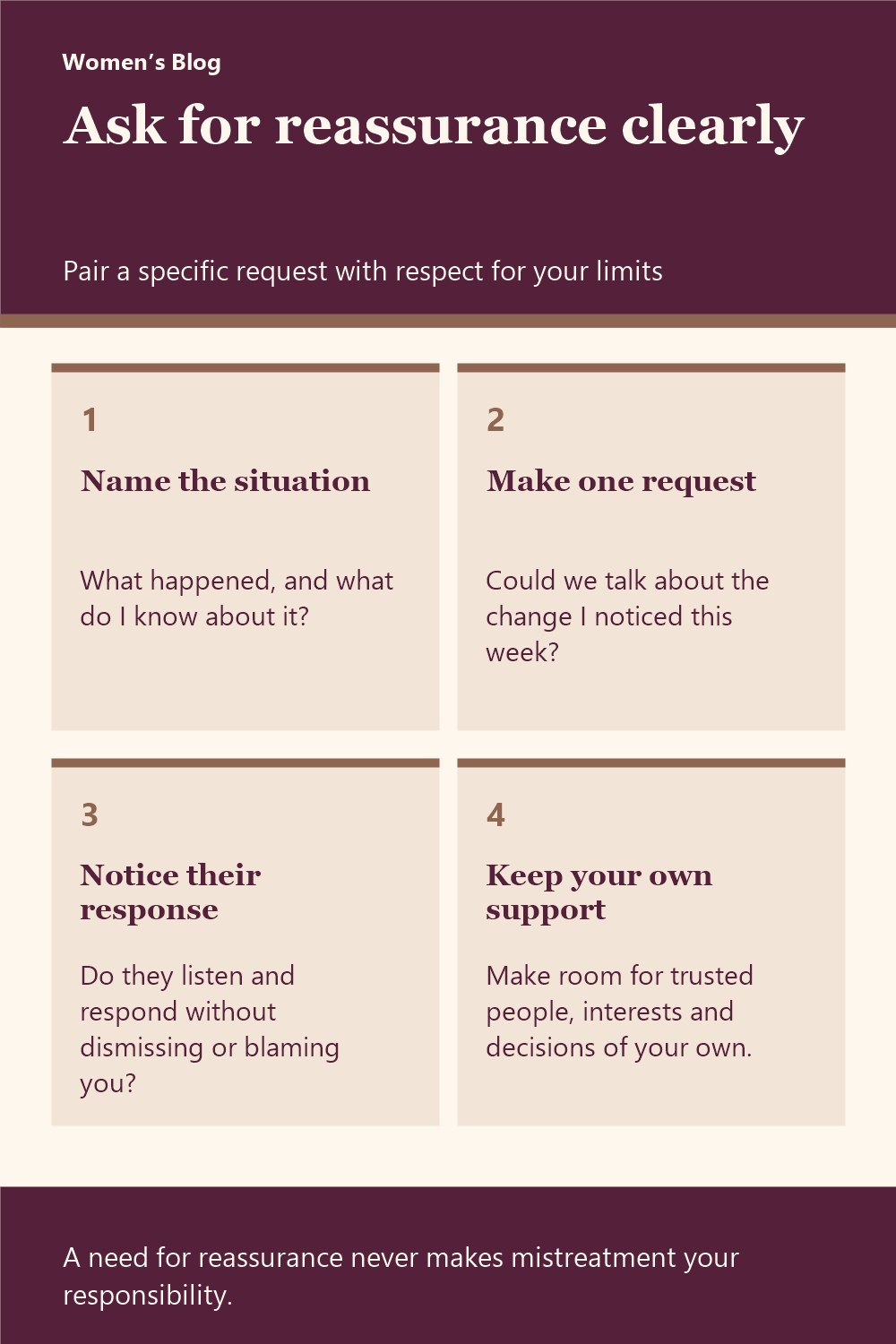
Read the infographic in text
Ask for reassurance clearly
- Name the situation What happened, and what do I know about it?
- Make one request Could we talk about the change I noticed this week?
- Notice their response Do they listen and respond without dismissing or blaming you?
- Keep your own support Make room for trusted people, interests and decisions of your own.
A need for reassurance never makes mistreatment your responsibility.