

A difficult situation does not have to become a positive experience to deserve your attention. Anger, sadness, disappointment or fear can be part of what you are facing. The aim is to understand the situation more clearly and find a response that fits your needs, rather than make yourself feel cheerful on demand.
You are not responsible for every event that happens to you. You may have choices about a next step without having caused the problem, welcomed it or been able to prevent it.
In this article
1. Name the difficult moment
Begin with a plain description of what happened and what it means to you. “My application was unsuccessful, and I feel disappointed” gives you something specific to work with. “Everything goes wrong because I am negative” turns one event into a judgment about your whole life.
If naming the feeling is difficult, describe what you notice: you want to leave a conversation, keep checking a message or postpone a task. You do not have to find a perfect label before taking a pause or asking for help.
Leave room for the real circumstances. Illness, loss, discrimination, money pressures and other people’s choices are not solved by adopting a brighter attitude. Acknowledging a problem is not a failure to be positive.
2. Check what you know and what you are assuming
Separate the event from the story you are adding to it. If a friend has not replied, the fact may be that you have not received a message. “They are angry with me” may be one possible interpretation, but you may not yet know why they have not answered.
Ask a few practical questions:
- What did I directly see or hear?
- What information am I missing?
- Am I treating one setback as proof that nothing can improve?
- Am I taking responsibility for someone else’s behaviour?
Checking a thought is not an instruction to dismiss evidence of harm. If someone repeatedly ignores a clear boundary, you can take that pattern seriously. A more balanced view includes the difficult facts as well as the uncertainty.
3. Try a fairer statement
A useful alternative thought should be believable. You do not need to replace “This is hard” with “Everything is wonderful.” A neutral statement may fit better: “This is hard, and I can decide what help I need.”
For a missed deadline, compare “I always ruin everything” with “I missed this deadline. I can ask what is still possible and plan differently for the next one.” The second version acknowledges your action without making it your entire identity.
The NHS guide to reframing unhelpful thoughts describes examining the evidence and considering a neutral or more helpful perspective. It also recognises that you may not be able to change a thought. You do not have to force an affirmation that feels untrue.

4. Choose one useful action
Ask what the situation needs now. It might be a clear question, a practical arrangement, rest or a limit on further contact. Choose something small enough to describe in an ordinary sentence.
- If you need information: write down the question you want to ask.
- If a task feels too large: identify its first manageable part.
- If someone crossed a boundary: decide what contact or support feels appropriate.
- If you are exhausted: consider what can wait and whether someone can share a task.
Some options may be limited by your energy, finances, access or responsibilities. Work with those limits rather than treating them as excuses you must overcome. An action can be worthwhile even when it does not change how you feel straight away.
5. Make room for time and support
Feelings may return after you have made a decision or taken a practical step. That does not erase what you did. You can revisit a thought without measuring whether you have finally become a positive person.
If it helps, review one specific question later: did the conversation clarify anything, did the smaller task fit, or do you need a different kind of help? Adjust the plan instead of using a difficult day as evidence against yourself.
You can talk to someone you trust or seek qualified support if distress is persistent or hard to manage. You deserve care while things are unresolved. Making space for what is real can sit alongside a useful next step, without requiring you to call the whole experience a blessing.
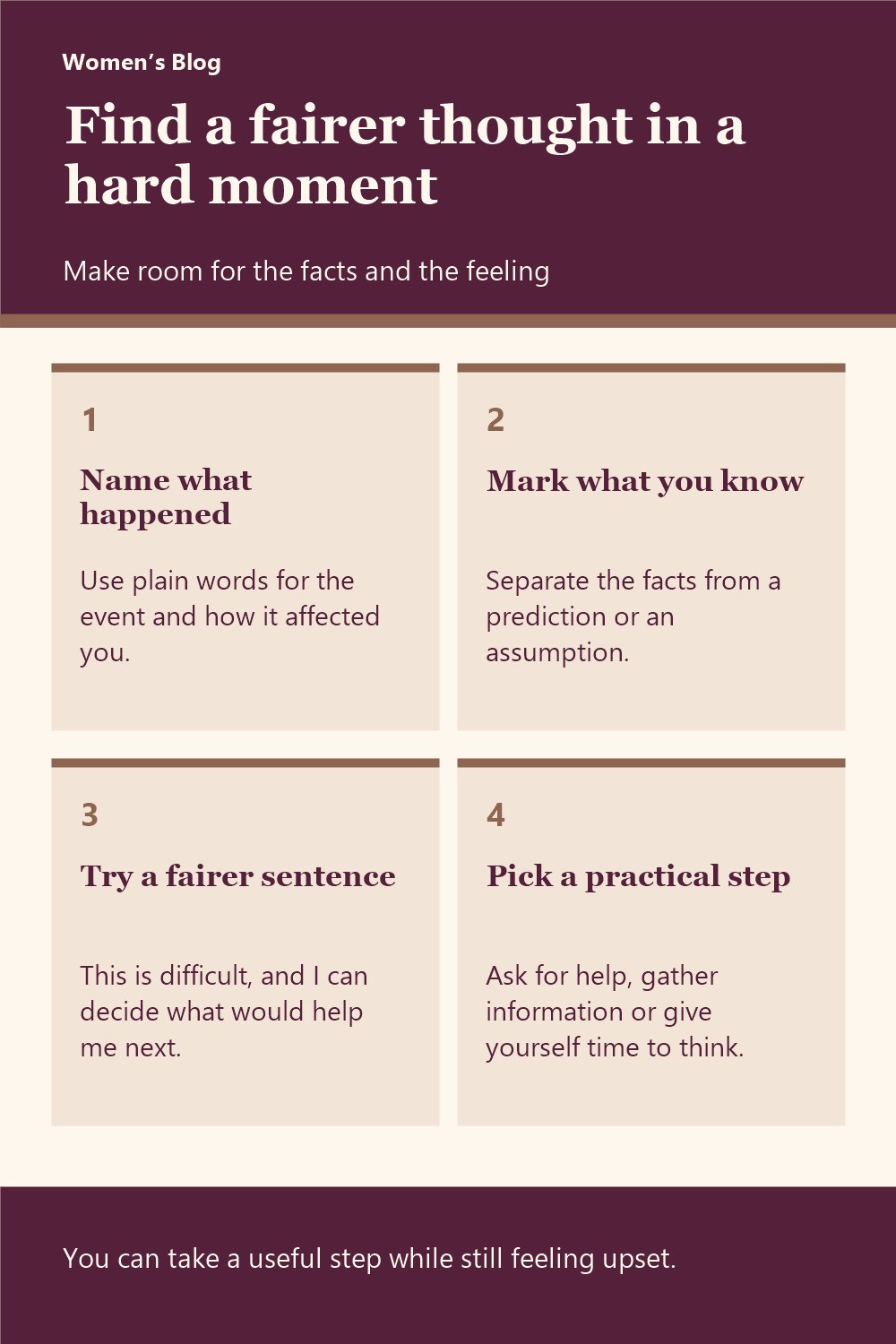
Read the infographic in text
Find a fairer thought in a hard moment
- Name what happened Use plain words for the event and how it affected you.
- Mark what you know Separate the facts from a prediction or an assumption.
- Try a fairer sentence This is difficult, and I can decide what would help me next.
- Pick a practical step Ask for help, gather information or give yourself time to think.
You can take a useful step while still feeling upset.