

Happiness is not entirely a choice, and feeling unhappy does not mean you have failed to think positively. Health, loss, money, relationships and demands on your time can all shape how life feels. Useful habits can support you without removing every difficulty.
Rather than trying to overhaul your personality, notice one pattern you would like to understand or change. Keep room for rest, practical help and feelings that do not disappear on demand.
On this page
1. Look at the circumstances as well as the habit
Ask what has changed and what is taking the most energy. An exhausting job, grief or an unsafe relationship cannot be reduced to a bad attitude. Naming the pressure can help you identify support, a practical adjustment or a decision that needs more time.
2. Set limits while staying compassionate
Listening to someone who is struggling can be part of a caring friendship. You can also have limits. Try asking whether they want company, help thinking through options or time to talk, then be honest about what you can offer.
A boundary might sound like, “I can listen for a little while, but I need to rest this evening.” Look at patterns of disrespect or pressure rather than labelling every person who complains as toxic.
3. Notice comparison and demands on attention
An online post gives you a limited view of someone’s life. If scrolling repeatedly leaves you feeling inadequate, try a specific change such as muting an account, turning off a notification or choosing a shorter time online.
There is nothing wrong with enjoying clothes, possessions or sharing photographs. Ask whether the activity is satisfying to you or has become an exhausting attempt to earn approval.
4. Balance solitude, rest and connection
Time alone can be restorative. It can also start to feel lonely when it lasts longer than you want. Choose a form of contact that fits your energy: a message, a brief call, shared lunch or a familiar group activity.
You do not have to push through every social occasion. If you want more connection but find it difficult to reach out, ask someone you trust for a small, specific kind of company.
5. Separate responsibility from control
You can acknowledge harm someone caused while considering what would help you now. Taking a practical step does not excuse the harm or make you responsible for it.
Choose a part you can influence, such as making an appointment, asking a question or setting a limit. Some situations need outside help, and some cannot be resolved quickly. Talking about them is not automatically unhelpful complaining.
6. Leave room for ordinary enjoyment
Notice what feels interesting, comforting or worthwhile: music, a conversation, something you make, a familiar place or a moment outdoors. Enjoyment does not have to be impressive or productive.
You can appreciate a good moment while still feeling sad or worried. Gratitude is an option, not a requirement to prove that you are coping well.
7. Choose a modest goal and respect fear
A small goal may provide direction when you want it. Rest or getting through a demanding week can also be a reasonable priority. Use the resources you have rather than comparing your pace with someone else’s.
Fear can signal a real concern as well as uncertainty. Check the situation before deciding whether a small step feels appropriate. You do not have to take an unsafe risk or ignore a warning to build a satisfying life.
8. Make room for support
If low mood persists, you lose interest in things you usually enjoy or daily life becomes hard to manage, consider speaking with a health professional. You can also tell a trusted person what you are finding difficult.
You do not need to solve every habit before asking for help. Start with one change or one conversation that feels workable, and adjust as you learn what you need.
Read the infographic in text
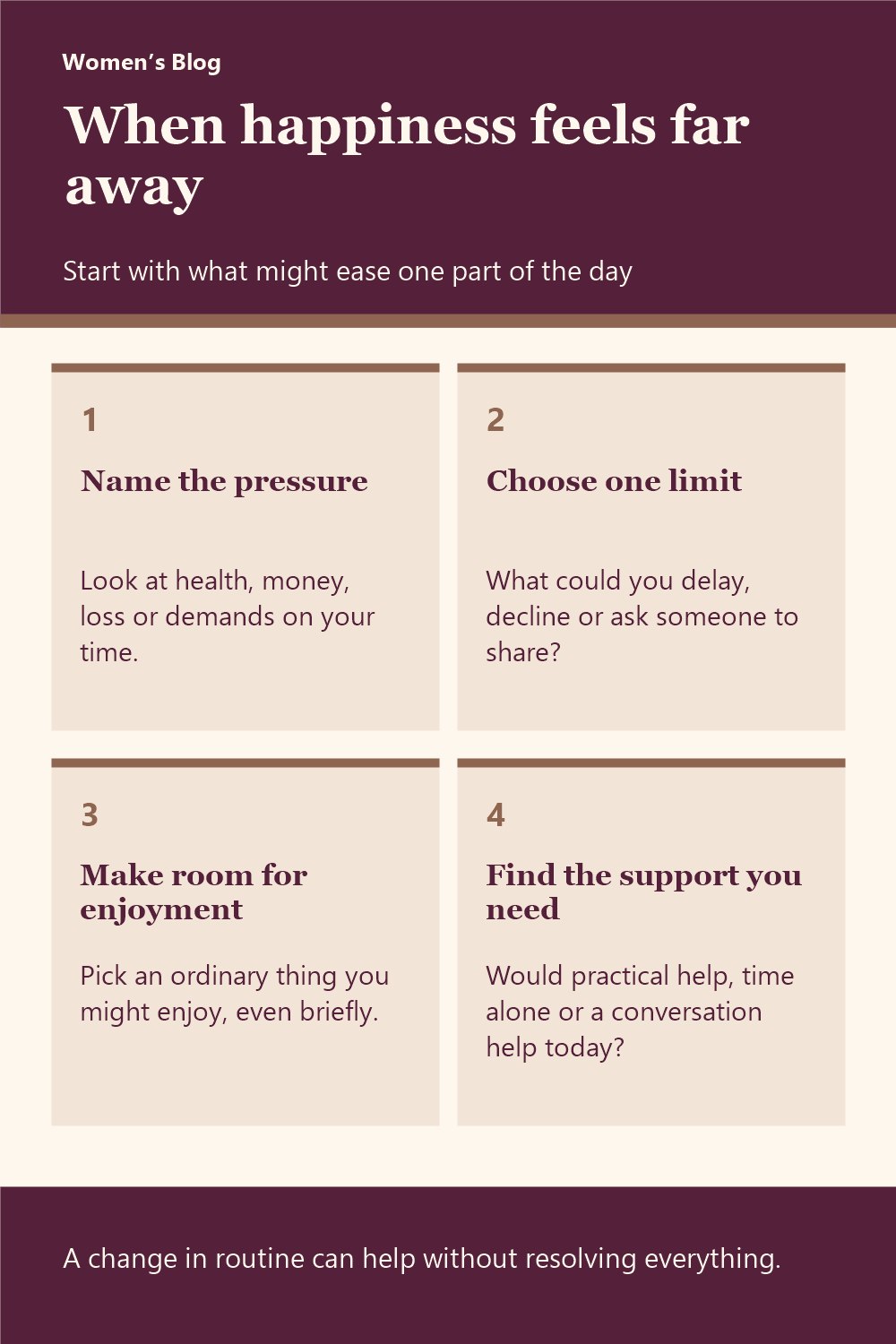
When happiness feels far away
- Name the pressure Look at health, money, loss or demands on your time.
- Choose one limit What could you delay, decline or ask someone to share?
- Make room for enjoyment Pick an ordinary thing you might enjoy, even briefly.
- Find the support you need Would practical help, time alone or a conversation help today?
A change in routine can help without resolving everything.