

A satisfying life can include joy, disappointment, uncertainty and periods when happiness feels distant. Relationships, health, work and money can matter a great deal. You do not have to deny their effect or discover a hidden supply of happiness inside yourself.
These 17 choices are prompts for reflection. Pick one that fits a current difficulty; you do not need to complete the list or feel better on a timetable.
On this page
- Separate influence from control
- Be selective about what you agree to
- Allow needs without expecting every outcome
- Take resentment seriously
- Distinguish guilt from responsibility
- Stay open to help and different perspectives
- Define what is sufficient for this task
- Make room for difficult feelings
- Look at patterns in relationships
- Protect a realistic amount of rest
- Acknowledge that money affects choices
- Plan for the future in manageable parts
- Consider fear before choosing a risk
- Give fear of loss a compassionate response
- Use comparison as limited information
- Review expectations when circumstances change
- Let the past matter without setting a deadline for healing
1. Separate influence from control
Name one part of the situation you can influence and one you cannot decide for someone else. Use that distinction to choose a useful action, such as asking a question or setting a limit. It does not mean ignoring a problem.
2. Be selective about what you agree to
Before saying yes, consider your time and energy. A clear “I cannot take that on this week” can be more workable than an agreement you cannot sustain. Someone being disappointed does not automatically mean your decision was unkind.
3. Allow needs without expecting every outcome
Your needs deserve consideration, even when life is unfair or another person cannot meet them. Ask directly where possible and consider other sources of support. An unmet need is information, not proof that you are asking too much.
4. Take resentment seriously
Ask whether resentment points to an unresolved hurt, unequal responsibility or a limit that keeps being crossed. You can consider a conversation, a change or support. Forgiveness is a personal choice and does not require renewed contact.
5. Distinguish guilt from responsibility
If you caused harm, consider an apology and a practical repair. If guilt follows a reasonable boundary, examine the expectation behind it. You do not need to accept blame for every unhappy reaction around you.
6. Stay open to help and different perspectives
You can ask for help, admit uncertainty or revise an opinion without losing dignity. Choose someone who respects your choices. Receiving support does not mean handing over all decisions about your life.

7. Define what is sufficient for this task
Choose what the task actually needs rather than an ideal version of it. A simple meal, a clear message or a completed first draft may serve the purpose. Save extra effort for the details that matter to you.
8. Make room for difficult feelings
Anger, sadness and worry can carry information. Notice them without treating each one as a command or a character flaw. You can discuss a problem and look for a next step without pretending everything is positive.
9. Look at patterns in relationships
Consider respect, reliability and the freedom to disagree. One hard conversation does not define a whole relationship, but repeated threats or control deserve attention. If you are afraid of someone’s reaction, seek support that puts your safety first.
10. Protect a realistic amount of rest
Look for a pause that fits the day, even when a full day off is not possible. If the load is consistently too much, consider what can be reduced, shared or renegotiated. Rest is not a reward reserved for a finished list.
11. Acknowledge that money affects choices
Basic needs and financial pressure matter. Avoid judging yourself against a lifestyle you cannot afford. A practical next step might be checking a bill, asking about an available service or discussing how a shared cost is handled.
12. Plan for the future in manageable parts
Separate a decision that needs attention from a prediction you cannot settle today. Identify the information you need and when you will review it. You can prepare for a possibility without solving every future scenario.
13. Consider fear before choosing a risk
Ask whether there is a real danger, an unfamiliar situation or both. If a small step is appropriate, keep it within your limits. Stopping, changing direction or asking for support can be thoughtful decisions rather than failures.
14. Give fear of loss a compassionate response
Wanting connection is understandable. When fear of being left drives you to accept treatment that hurts you, talk with someone supportive about your needs and options. You do not have to dismiss the fear to make a careful choice.
15. Use comparison as limited information
You rarely see another person’s entire life. Notice what a comparison brings up, then ask whether it points to something you value or simply adds pressure. Return to a goal or activity that fits your own situation.
16. Review expectations when circumstances change
A plan may need to change after illness, loss, a new responsibility or information you did not have before. Adjusting it does not erase what you hoped for. Give yourself time to decide what still matters.
17. Let the past matter without setting a deadline for healing
An experience can continue to affect you even when you want to move forward. You can make room for memories, grief or ongoing support while choosing something useful in the present. If distress is persistent or hard to manage, consider professional help.
Read the infographic in text
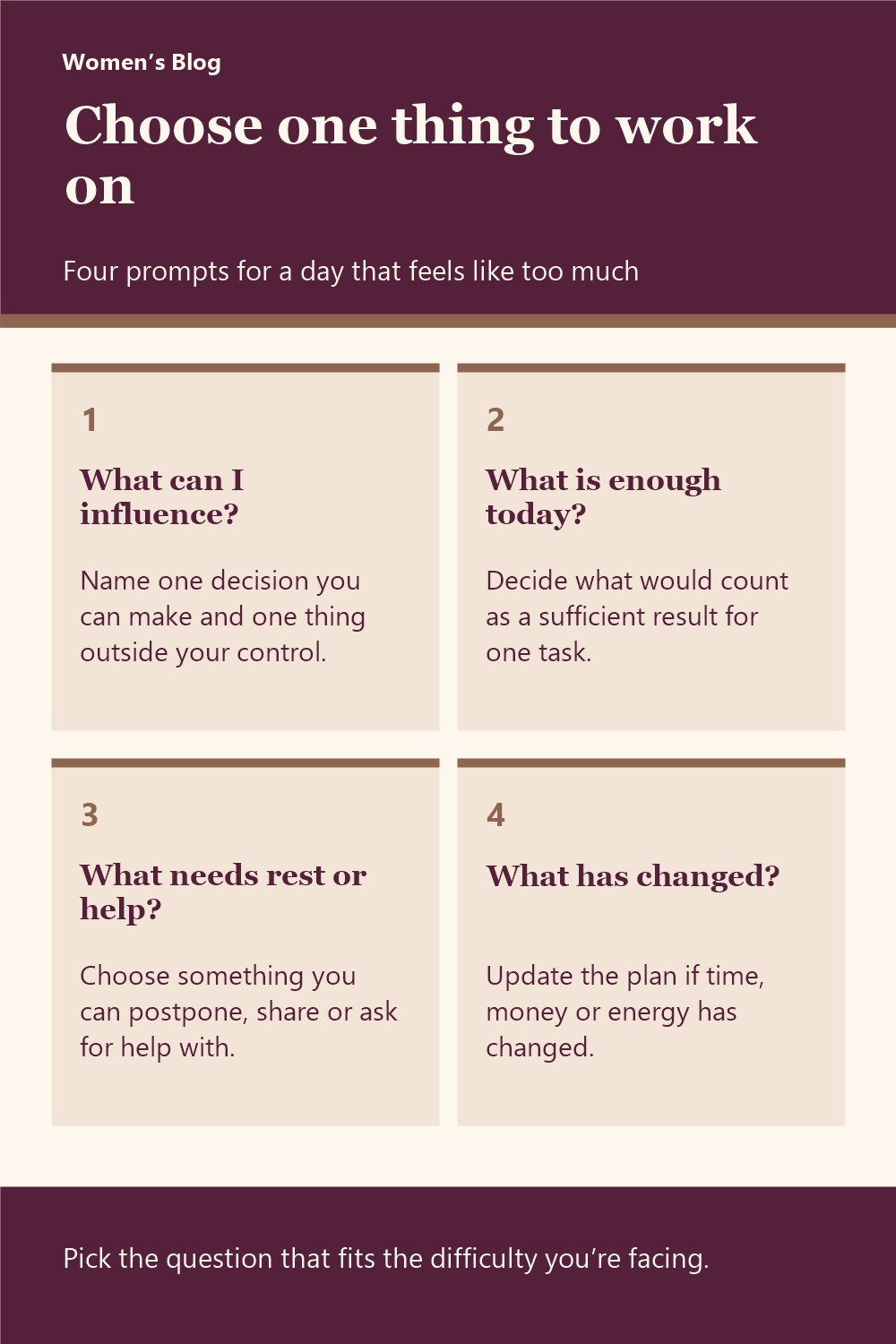
Choose one thing to work on
- What can I influence? Name one decision you can make and one thing outside your control.
- What is enough today? Decide what would count as a sufficient result for one task.
- What needs rest or help? Choose something you can postpone, share or ask for help with.
- What has changed? Update the plan if time, money or energy has changed.
Pick the question that fits the difficulty you’re facing.