

Do you keep working after you are exhausted, dismiss your own needs or speak to yourself more harshly than you would to a friend? Those experiences deserve care. They do not establish that you have a particular personality disorder or that you want to suffer.
Instead of giving yourself a label, look at the situations in which a pattern appears and what makes a different response difficult. You can begin with one manageable change while leaving room for professional support.
On this page
- Name the behavior without turning it into your identity
- Leave room for more than one explanation
- Respond to the harsh thought with something fair and specific
- Practise one limit before you are completely depleted
- Make room for rest and help without earning them first
- Seek support when the pattern is hard to shift
1. Name the behavior without turning it into your identity
Try a specific observation: “I agreed to another task even though I had no time,” or “I called myself useless after one mistake.” This is more workable than deciding that you are fundamentally self-defeating.
Notice the circumstances as well: the demand, the people involved, your energy and what you feared might happen if you responded differently. A pattern can vary across situations; it does not describe everything about you.
2. Leave room for more than one explanation
Past experiences may matter, but a short checklist cannot establish why you feel or act a certain way. Current stress, expectations, practical constraints and relationships may also be relevant. You do not need to settle on a single cause before seeking help.
If someone has mistreated you, that is not evidence that you wanted or invited it. Responsibility for abuse belongs to the person choosing abusive behavior. Support can focus on your present needs without requiring you to blame yourself.
3. Respond to the harsh thought with something fair and specific
You do not have to replace criticism with praise you do not believe. Try a statement that recognises the difficulty and leaves a next step: “That conversation went badly. I can think about what to clarify when I have rested.”
The NHS guidance on low self-esteem suggests noticing negative beliefs and considering evidence that challenges them. If writing helps, record the thought and a more balanced response. Stop or change the exercise if it becomes another way to judge yourself.
4. Practise one limit before you are completely depleted
A limit can be small: asking for time before answering, declining one extra task or stating when you are available. For example: “I cannot take that on today. I can discuss it on Thursday.” You do not need to justify every detail.
If someone responds to a reasonable limit with threats or control, the difficulty is not simply your lack of confidence. Consider support and safety rather than treating more assertiveness as the only solution.
5. Make room for rest and help without earning them first
Choose a practical action suited to today: take a break, eat something, ask someone to share a task or leave a nonessential job unfinished. Rest and care do not have to be rewards for getting everything right.
When accepting help feels uncomfortable, begin with a specific request you can discuss: “Could you collect that item for me?” or “Would you listen for ten minutes?” You are allowed to need support and to have preferences about it.

6. Seek support when the pattern is hard to shift
If self-criticism, guilt or overwork is affecting your relationships, sleep or daily functioning, consider talking with a qualified mental health professional or primary care clinician. They can help assess what is happening and discuss suitable support. You do not need a self-diagnosis to ask.
Progress may involve noticing a thought sooner, keeping one boundary or recovering after a difficult day. These are useful changes even if the inner criticism has not disappeared. Choose a next step you can review with curiosity rather than another demand for perfection.
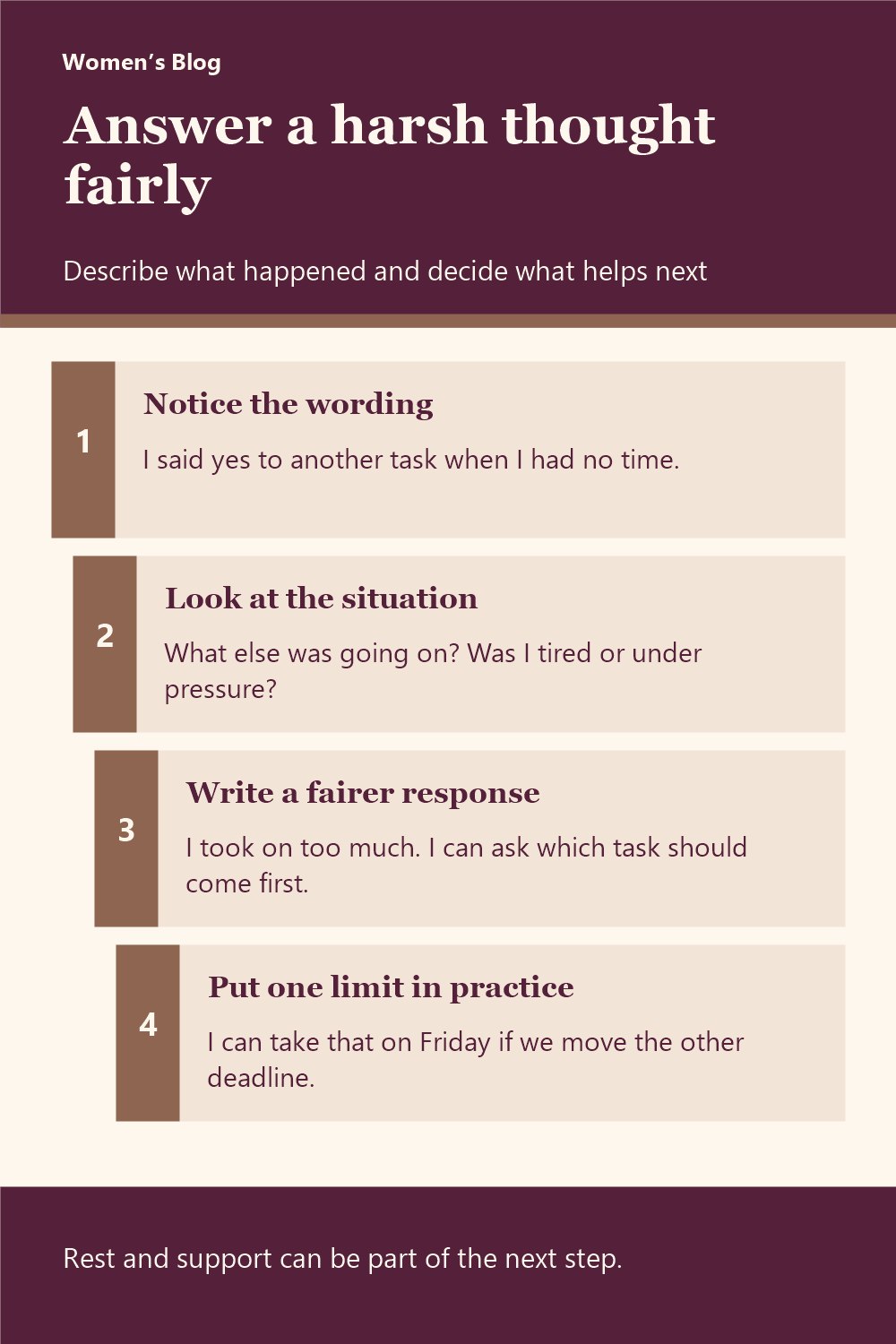
Read the infographic in text
Answer a harsh thought fairly
- Notice the wording I said yes to another task when I had no time.
- Look at the situation What else was going on? Was I tired or under pressure?
- Write a fairer response I took on too much. I can ask which task should come first.
- Put one limit in practice I can take that on Friday if we move the other deadline.
Rest and support can be part of the next step.