

Self-love does not have to mean feeling confident or positive about yourself all the time. It can mean treating your needs as worth considering, responding fairly to mistakes and choosing how you want to care for yourself.
If the phrase feels uncomfortable, start with respect or kindness. These are practices you can try on an ordinary day, rather than feelings you must produce before you can move forward.
On this page
- Let confidence be specific
- Treat worth as more than performance
- Choose an action of care
- Use a fairer inner voice
- Notice when comparison stops being useful
- Make room for your own priorities
- Reflect in ways that fit your beliefs
- Look for respectful company
- Pair compassion with repair
- Adapt habits to the body and life you have
- Respond to harsh thoughts rather than ordering them away
- Allow neutrality where love feels difficult
- Keep care available on difficult days
1. Let confidence be specific
You may feel capable in one part of life and uncertain in another. Choose a skill you want to practise and make the next attempt manageable. Needing preparation or help does not cancel the abilities you already have.
2. Treat worth as more than performance
Notice whether you only allow yourself respect after achieving something. Try describing yourself in words that include values, interests and relationships as well as results. A mistake or someone’s criticism does not provide a complete account of who you are.

3. Choose an action of care
Ask what would help today: a meal, a break, a clear boundary, an appointment or company. Choose one available action. Self-care can be practical and modest; it does not need to look like a purchase or a perfect routine.
4. Use a fairer inner voice
Consider what you would say to someone you care about in the same situation. Keep the response honest: “That was difficult, and there is one part I can repair.” Kindness can include responsibility without adding insults.
5. Notice when comparison stops being useful
Learning from someone else can be helpful. Treating their success as proof of your inadequacy usually gives you less useful information. Ask which part, if any, you want to learn from, then return to your own circumstances.
6. Make room for your own priorities
Choose something you would like to explore, improve or protect. It might be an interest, a relationship or a little more rest. Small actions count, and a change in priorities is allowed as your needs and resources change.
7. Reflect in ways that fit your beliefs
You might use journaling, prayer, meditation or a sense of spiritual guidance to reflect on what matters to you. If spirit guides are part of your beliefs, consider what a compassionate reflection would invite you to notice. You can also seek practical information and talk with someone you trust.
8. Look for respectful company
Notice whether people can hear a boundary, respect a difference and make room for your feelings. No friend can offer encouragement constantly. Look at the pattern of the relationship and discuss a specific need when it feels safe to do so.
9. Pair compassion with repair
If you have hurt someone, name what happened, listen and consider a meaningful repair. You cannot require forgiveness or an immediate return to closeness. Caring for yourself includes learning from an action without deciding that it defines your whole character.
10. Adapt habits to the body and life you have
Choose food, movement, rest and routines that are available and appropriate for you. A gentle activity or a simpler meal may fit better than an ambitious plan. Pain, disability, caring duties and limited resources deserve consideration in the plan.
11. Respond to harsh thoughts rather than ordering them away
When a thought says “I always fail,” ask what happened this time and what evidence the word “always” leaves out. You can use a more specific description without forcing a cheerful one. Recurring distress may be something to discuss with a professional.
12. Allow neutrality where love feels difficult
You do not have to admire every part of yourself to treat yourself decently. “This is how I feel today, and I still need care” may be a more workable starting point than insisting on complete acceptance.
13. Keep care available on difficult days
Plan a few small supports you can return to when things are hard, such as a trusted contact or a manageable routine. Missing a day does not mean you have lost the ability to care for yourself. Adjust the practice instead of turning it into another test.
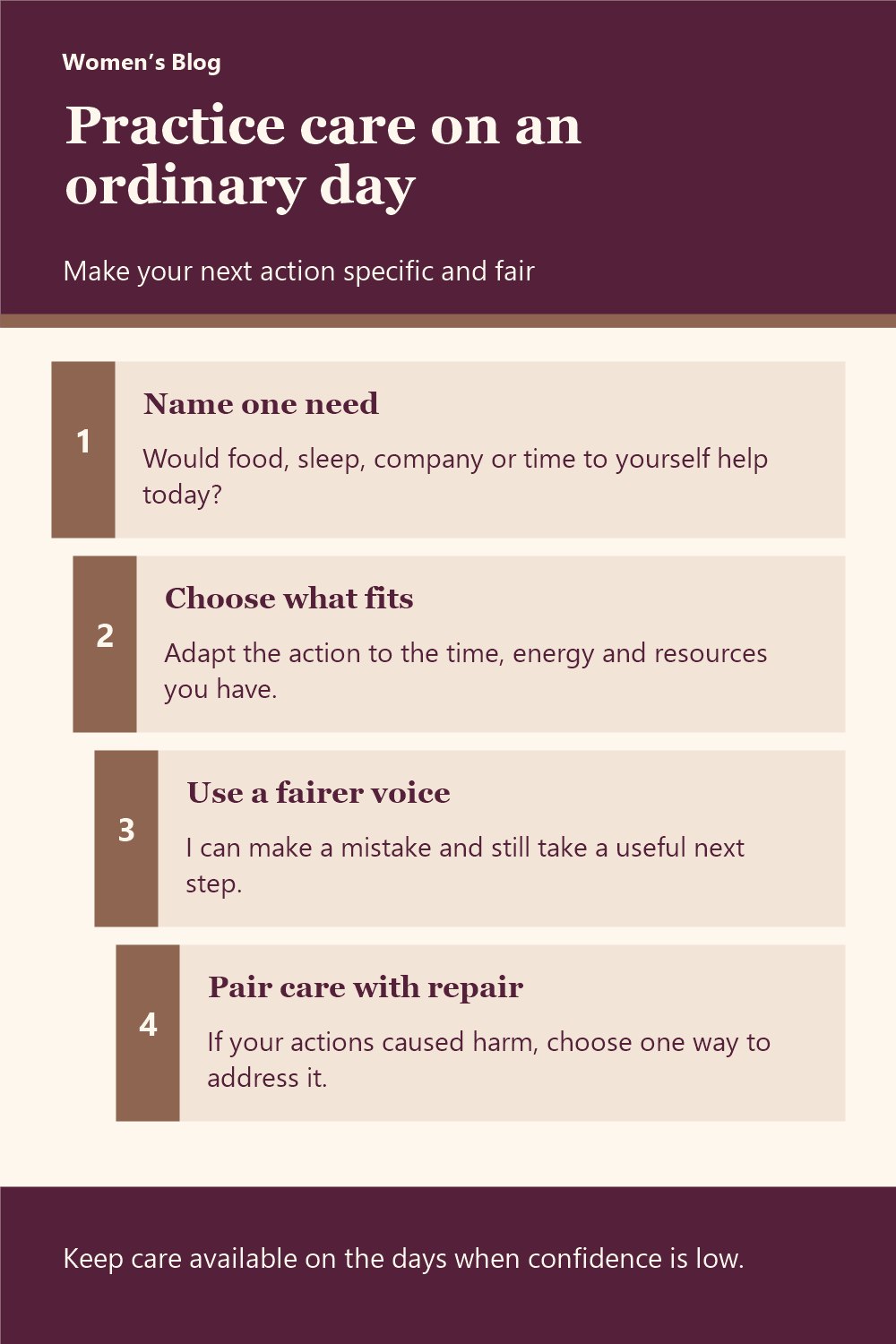
Read the infographic in text
Practice care on an ordinary day
- Name one need Would food, sleep, company or time to yourself help today?
- Choose what fits Adapt the action to the time, energy and resources you have.
- Use a fairer voice I can make a mistake and still take a useful next step.
- Pair care with repair If your actions caused harm, choose one way to address it.
Keep care available on the days when confidence is low.