

Wanting time to yourself does not automatically mean something is wrong with your relationship. You can care about a partner and also want room for your own interests, friendships or quiet.
My husband and I have built “me time” into our marriage. This helps us to boost our relationship’s growth and our commitment to each other. I love to read, so I spend personal time doing that. My husband likes playing video games and doing physical training. Sometimes he’ll take an early morning walk alone to help keep his mind fresh.
That arrangement works for us. Other couples may need different amounts of time apart. A useful plan respects both people and the responsibilities they share.
On this page
1. Explain what kind of space you need
“I need space” can mean a quiet hour, time with friends, a pause in an argument or uncertainty about the relationship. Give enough detail to avoid leaving your partner to guess.
Try: “I’d like half an hour to read after dinner, then I’d enjoy catching up with you.” You can explain a preference without promising constant availability or asking permission for every ordinary activity.
2. Ask what the request brings up
If your partner asks for time alone, check what they mean before deciding it signals rejection. If you are the person asking, listen to a concern without treating it as proof that your need is unreasonable.
A reassurance can be simple: “I’m looking forward to seeing you afterwards.” You do not have to offer repeated updates, location tracking or access to private messages to make personal time acceptable.
3. Make the practical arrangements fair
Consider children, other care needs, household work, paid work and rest. One person’s free time should not quietly depend on the other person carrying every shared responsibility.
Discuss who is handling what and how both people get a realistic opportunity to take a break. Fairness may require different arrangements on different days, rather than an exact match of minutes.
4. Let the activity suit the person
Reading, drawing, exercise, music, seeing friends or simply sitting quietly can all be ordinary ways to spend personal time. Choose what you enjoy and what your energy, access needs and budget allow.
It does not have to produce a result, improve your appearance or make you a more entertaining partner. You are allowed an interest that is simply yours.

5. Agree on how to reconnect
A loose plan can make time apart less confusing: share a meal later, check in after an outing or arrange another evening together. If plans change, communicate practical information rather than leaving the other person waiting.
Also discuss shared time you both want. Time alone and time together serve different needs; neither has to prove that the relationship is perfect.
6. Notice the pattern over time
Personal time is different from repeatedly disappearing, using silence to punish someone or refusing to discuss shared responsibilities. On the other side, affection does not justify controlling a partner’s friendships, movements or access to money.
If you keep feeling disconnected, talk about the specific pattern rather than arguing over whether “space” is good or bad. If you feel unsafe raising a need, seek private support. You do not have to become completely happy or independent before you deserve respect and care.
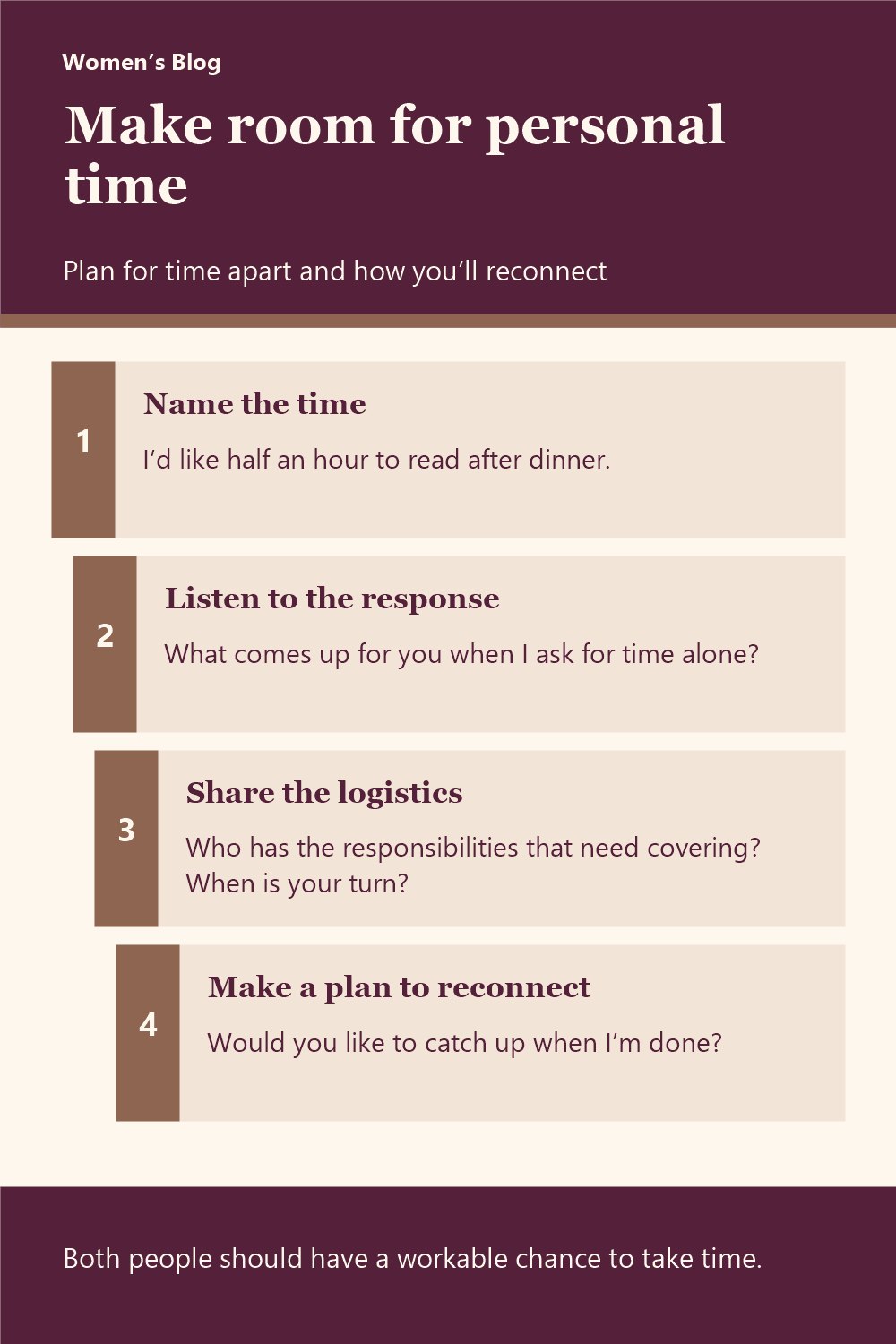
Read the infographic in text
Make room for personal time
- Name the time I’d like half an hour to read after dinner.
- Listen to the response What comes up for you when I ask for time alone?
- Share the logistics Who has the responsibilities that need covering? When is your turn?
- Make a plan to reconnect Would you like to catch up when I’m done?
Both people should have a workable chance to take time.