

Balancing paid work, family responsibilities and your own needs can be difficult even with a well-organised calendar. Childcare costs, shift patterns, health needs and limited support can shape your choices. Feeling stretched does not mean you care too little or have failed to manage your time.
Start with one pressure you might be able to reduce. The aim is a more workable arrangement for your circumstances, with room to review it when those circumstances change.
On this page
1. See the whole workload
List paid hours, travel, care, household tasks and the planning that makes those tasks happen. Include remembering appointments, arranging childcare and managing unexpected changes, rather than counting only visible chores.
Look for the hardest points in the week. Is it the morning handover, a late shift, school collection or the work that resumes after everyone else rests? One specific pressure is easier to discuss than a general instruction to find balance.
2. Share responsibility where support is available
If you share a household or care responsibilities, discuss who owns each task from start to finish. An arrangement is clearer when someone handles the planning and follow-through, rather than waiting to be reminded.
Single parents and carers may have fewer people to share with. Consider what help is actually available through trusted people, school, care services or community resources. A lack of support is a practical constraint, not a personal shortcoming.
3. Ask about workload and priorities at work
Where possible, bring a concrete request to an appropriate person: “These two deadlines overlap. Which should take priority?” or “Could we discuss a more predictable finishing time?” An agreed change is more useful than silently trying to absorb another task.
The UK Health and Safety Executive’s guidance for workers suggests talking about work-related stress and identifies alternatives such as HR or a representative when the manager is part of the problem. Use the support and policies relevant to your own workplace and location.

4. Check the practical effects of a change
Part-time work, freelance work or a different role may suit some families and create difficulties for others. Before making a commitment, check likely income, predictable hours, care arrangements, benefits and the costs involved. Freelancing does not automatically provide more time or reliable earnings.
If the decision is complicated, seek suitable advice and compare realistic options. You do not have to make a major career change to justify needing a more manageable week.
5. Make transitions and family time realistic
A short transition after work may help, but not everyone has fifteen uninterrupted minutes on arriving home. You might change clothes, have a drink or agree a brief handover with another adult when available.
For time together, choose something that fits the day: a meal, a conversation, a story or a shared task. Put devices aside when practical, while recognising that work calls, accessibility needs and care arrangements may sometimes require them.
6. Protect some room for your own needs
Rest, food, health appointments, friendships and interests belong in the picture too. They are not extras that become legitimate only when everyone else needs nothing from you.
Ask whether a nonessential activity can be postponed, simplified or shared. You may still feel guilty about a reasonable choice. That feeling does not by itself show that you are letting your family down.
7. Try one adjustment and revisit it
Choose a small change with a clear owner and a review point: a different collection arrangement, fewer optional commitments or a discussion about one recurring deadline. Notice what becomes easier and what still needs support.
Some pressures require changes from an employer, a household or a wider support system. A better routine can help, but it cannot make an impossible workload sustainable on its own.
Read the infographic in text
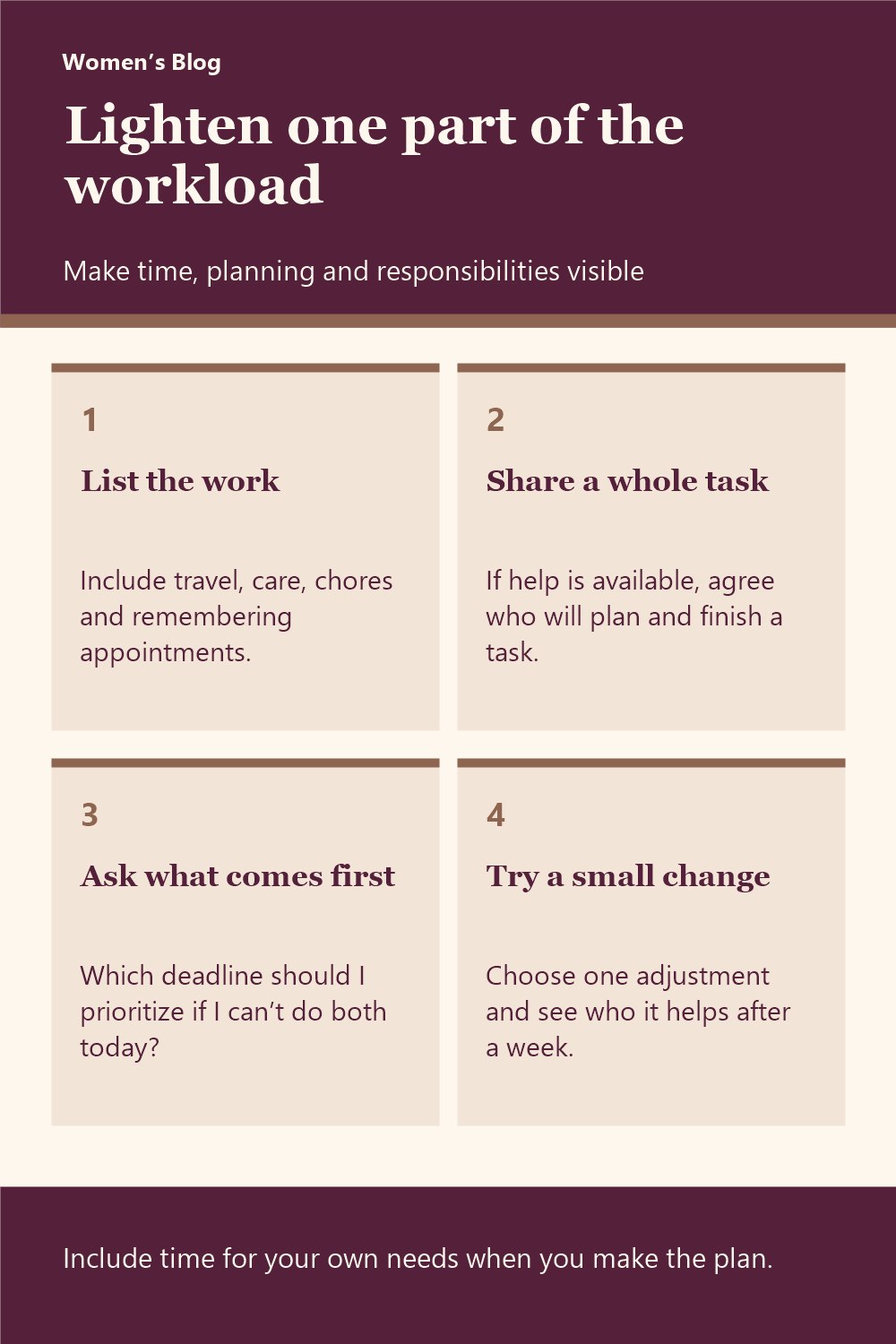
Lighten one part of the workload
- List the work Include travel, care, chores and remembering appointments.
- Share a whole task If help is available, agree who will plan and finish a task.
- Ask what comes first Which deadline should I prioritize if I can’t do both today?
- Try a small change Choose one adjustment and see who it helps after a week.
Include time for your own needs when you make the plan.