

Defending your pride can make an ordinary disagreement harder to repair. You might interrupt, refuse to acknowledge a mistake or keep trying to win after the original issue has been lost.
Calling yourself or a partner “evil” does not clarify what needs to change. A more useful question is: “What am I doing in this conversation, and what would a respectful response look like?”
Repair is a shared process. It does not require accepting humiliation, ignoring repeated harm or preserving a relationship at any cost.
On this page
1. Make room for repair and boundaries
If you both want to work through a disagreement, agree on what you are trying to understand or resolve. You can value the relationship while still saying that a particular behaviour is unacceptable.
When you are too upset to speak respectfully, ask for a pause and a time to return: “I need a little time to settle. Can we talk again after dinner?” A clear pause differs from leaving someone in indefinite silence as punishment.
2. Treat each other as equals
Differences in income, education, confidence or experience do not give one partner greater authority over the other. Talk about how decisions and responsibilities are shared instead of assuming that a gender or a pay cheque should determine who leads.
Accepting a person’s individuality is different from accepting every action. You can respect a difference in taste and still object to insults, dishonesty or controlling behaviour.
3. Take responsibility when you are wrong
Name the action and its impact without turning the apology into a defence: “I interrupted you and dismissed your concern. I’m sorry. I want to hear the rest.” Only say what you mean and what you are willing to follow through on.
Being wrong about one thing does not make you worthless. You can acknowledge a mistake, correct what is possible and change the behaviour without asking the other person to immediately reassure or forgive you.

4. Keep communication specific and open
Describe what happened and what you are asking for. “Could we agree how to divide this bill?” is more workable than “You never respect me.” Listen to the answer and check that you understood it before replying.
Where there is a genuine disagreement, look for options both people can freely accept. Agreement reached through intimidation or exhaustion is not the same as working something out together.
5. Separate defensiveness from self-respect
It may be pride to insist that you can never be mistaken. It is a boundary to decline a conversation full of threats or insults. Those situations need different responses.
Ask yourself: “Am I protecting my image, or am I protecting something I need, such as privacy, safety or fair treatment?” If you are unsure, talking privately with someone you trust can help you think clearly.
6. Notice whether the effort is mutual
Look for behaviour after the conversation: listening, changed actions and responsibility for agreed tasks. One person cannot supply honesty, care and accountability for both partners.
You may choose to continue working on the relationship, seek appropriate support or decide it no longer suits you. Forgiveness and reconciliation are choices, and they do not have to happen together. You do not need to label a necessary decision as a failure of love.
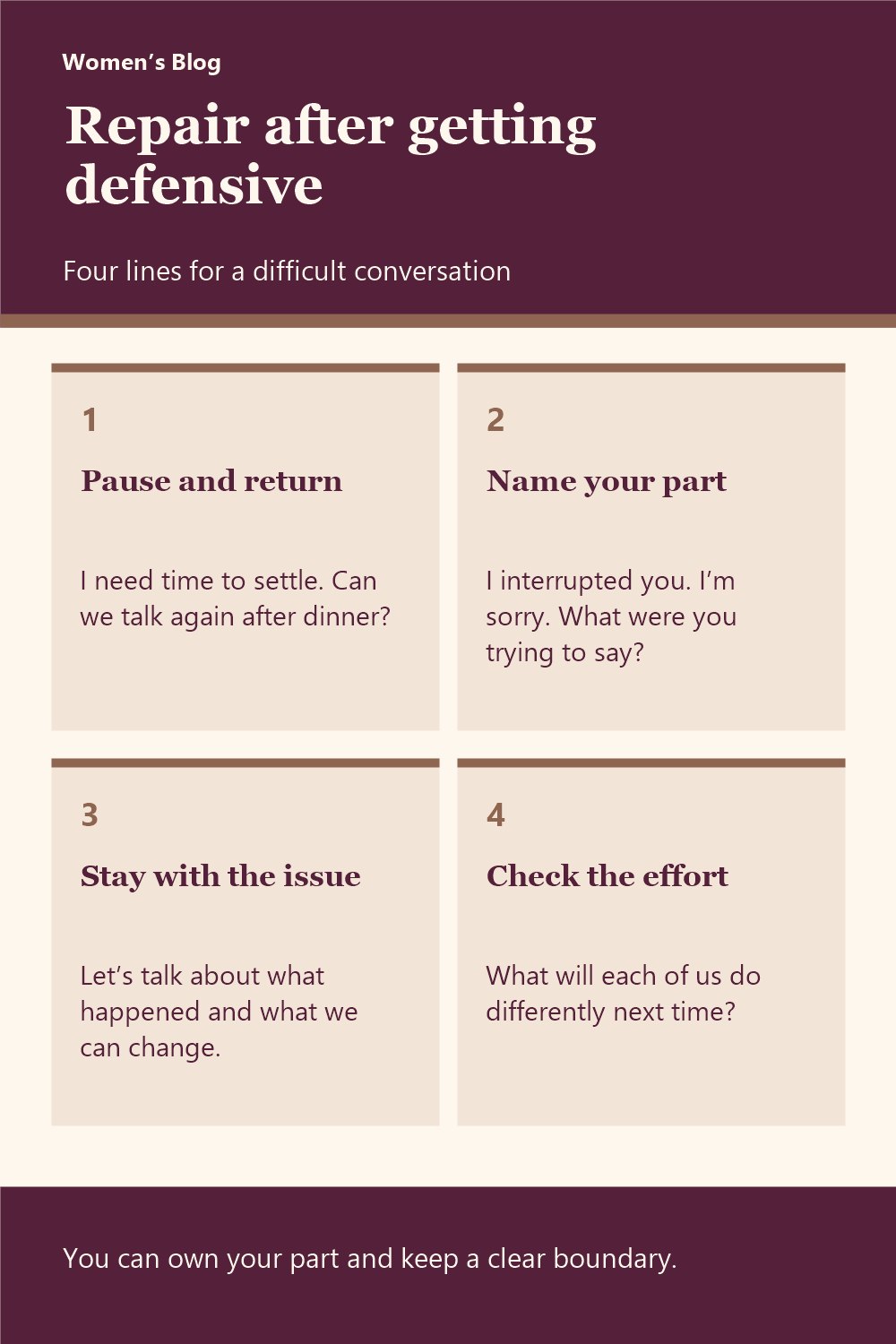
Read the infographic in text
Repair after getting defensive
- Pause and return I need time to settle. Can we talk again after dinner?
- Name your part I interrupted you. I’m sorry. What were you trying to say?
- Stay with the issue Let’s talk about what happened and what we can change.
- Check the effort What will each of us do differently next time?
You can own your part and keep a clear boundary.