

Self-love can be an ordinary decision to take your needs seriously: eating before another task, asking for a fairer share of the work or giving yourself time to answer a request. You do not have to feel confident, cheerful or pleased with yourself first.
A long self-care checklist can become another demand. Instead, use the ideas below to choose something that fits your day. Money, disability, caring responsibilities and working hours affect what is possible. Needing help with those circumstances does not mean you are failing to care for yourself.
On this page
1. Start with the need in front of you
Before choosing an activity, ask what is making today difficult. Are you hungry, tired, lonely, interrupted or carrying too many responsibilities? These needs may call for different responses. Buying a treat might be enjoyable while leaving an unfair workload unresolved.
Try a concrete description: “I have not had lunch,” “I need some quiet” or “I need help arranging this appointment.” You can then choose an action that addresses part of the problem. There is no requirement to improve every area of your life at once.
The National Institute of Mental Health’s self-care guidance includes regular meals, hydration, rest, movement and supportive contact. Adapt everyday care to your health and access needs. Movement can be a comfortable activity you choose, rather than a daily test of willpower.
You do not need a special drink to “clear out” your body or a salt bath to protect your mind. If bathing is pleasant and suitable for you, it can simply be a comfortable pause. Leave out anything that irritates you or adds difficulty.
2. Use words you can believe
When your inner commentary becomes harsh, describe the event more accurately. “I forgot something and need to make a new arrangement” is different from “I ruin everything.” A fair description leaves room to take responsibility without condemning your whole self.
The NHS guide to low self-esteem suggests noticing negative beliefs, considering evidence and treating yourself with the kindness you might offer a friend. A believable reminder can be enough: “This is difficult, and I can ask for help with one part.”
Mirror exercises and repeated affirmations are optional. You can care for yourself through an action even when flattering statements feel uncomfortable. For more examples, read Self-Kindness in Everyday Life: Boundaries, Care and Room to Be Human.
Gratitude is optional too. You might notice one thing you appreciated without completing a list of ten. Appreciation can sit alongside sadness, anger or an honest account of a difficult day; you do not have to find a positive meaning in harm.

3. Choose a break that fits your life
Think about the kind of pause you want. You might prefer a conversation, a familiar song, some privacy, a few minutes outside or a comfortable place to sit. Nature is one option; a safe indoor space may be more accessible or appealing.
If your phone keeps interrupting you, try pausing nonessential alerts for a period you can manage. Keep necessary care, work or emergency contact available. Someone who depends on a device for communication or support does not need to unplug for hours to practise self-care.
A journal can hold a few unfinished lines, and a hobby can stay small. You do not have to explain every feeling, complete a project or turn rest into something productive. If writing makes you dwell on a problem without helping, choose another activity.
For everyday alternatives to a formal practice, see Ways to Stay Calm without Meditating. Choose according to your circumstances rather than treating every suggestion as another task.
4. Make boundaries specific
Look at behaviour and its effect on you instead of sorting people into “positive” and “negative” types. A friend can be going through a hard time and still respect your limits. Equally, someone’s cheerful manner does not make repeated insults or pressure acceptable.
For an ordinary request, state what you can offer: “I can talk for a little while this evening,” or “I cannot take on the extra task this week.” You can care about another person while recognising your own capacity. They may have limits too.
If a relationship is draining, consider what would change the situation: fewer interruptions, a more balanced division of work, a conversation about a particular comment or less contact. A vague label such as “energy vampire” does not tell you which action is needed.
Leaving a relationship or changing family contact can involve housing, money, children and safety. Do not judge yourself for being unable to create distance immediately. If someone threatens, controls or frightens you, seek support with your safety and options rather than relying on a perfect boundary statement to change their behaviour.
5. Make one small, adjustable plan
Choose an action, when it could happen and what you will do if the first version is unavailable. For example: “After work, I will have something to eat before starting another chore. If cooking is too much, I will use an easy option I already have.”
Another plan might involve sharing a demand: “Tonight I will ask whether we can divide the weekend errands.” The other person’s response matters; self-care does not mean becoming endlessly better at managing everything alone.
Afterward, ask what made the action easier or harder. A missed plan may need a different time, fewer steps or practical help. Acknowledge what you managed without making care a reward you must earn by meeting goals.
6. Include support when you need it
Be specific about the support you want: company, listening, transport, help with a form or someone to share a responsibility. Check whether the person is available, and decide how much you want to disclose. Privacy and receiving care can coexist.
If low self-worth, distress or changes in your usual activities persist or feel difficult to manage, consider talking with a qualified health professional. You do not have to finish a self-help routine before asking. Everyday care can support treatment; it does not replace help with a health concern.
Start with the need that matters today, and leave room to revise your plan. Self-love does not require a perfect routine or a consistently positive mood. It can mean giving yourself the same practical consideration you would want for someone you care about.
Read the infographic in text
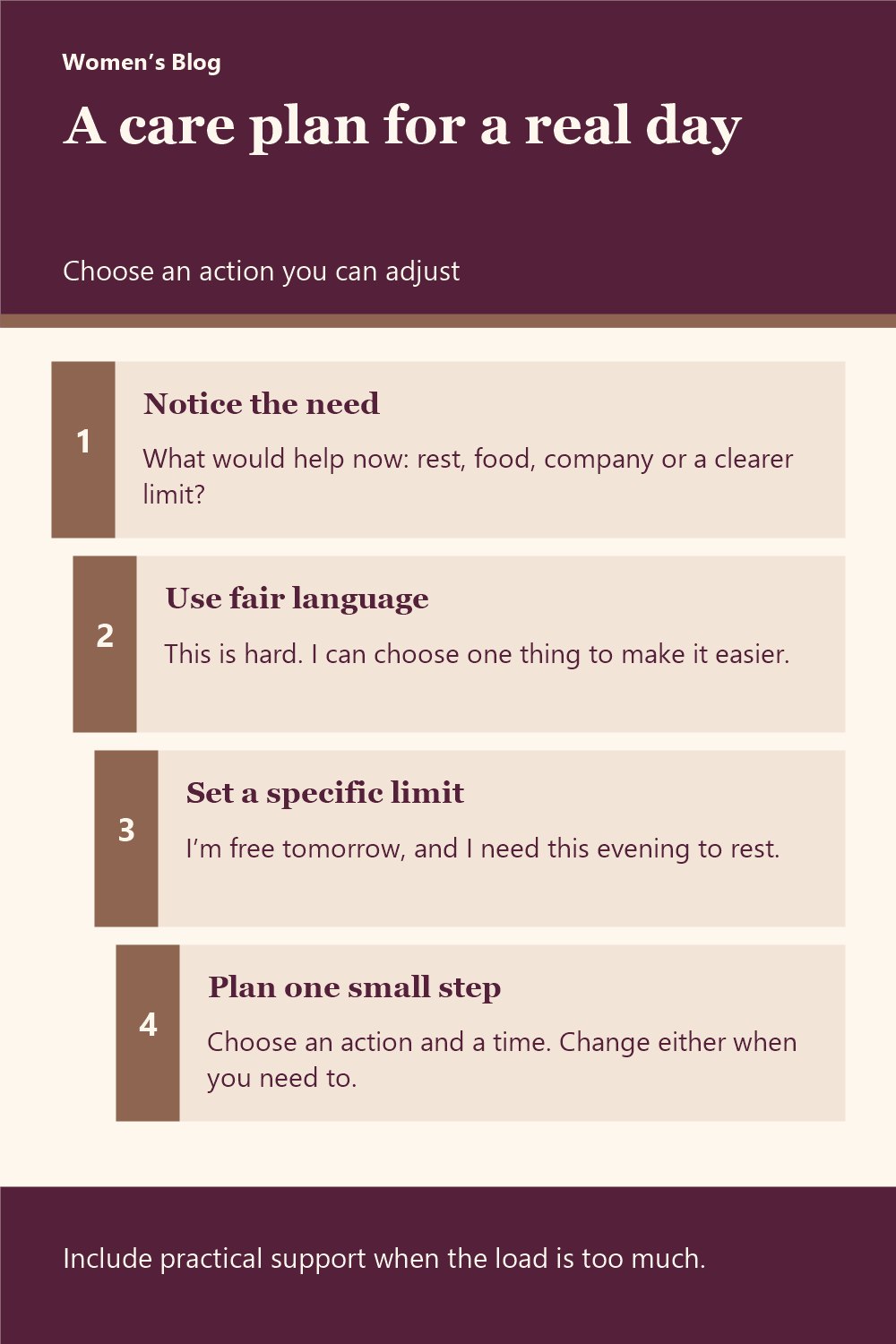
A care plan for a real day
- Notice the need What would help now: rest, food, company or a clearer limit?
- Use fair language This is hard. I can choose one thing to make it easier.
- Set a specific limit I’m free tomorrow, and I need this evening to rest.
- Plan one small step Choose an action and a time. Change either when you need to.
Include practical support when the load is too much.