

When stress builds up, the aim is to make life more manageable: reduce pressure where possible, allow time to recover and get support with what remains. A more positive attitude cannot remove every demand or solve every difficult circumstance.
Begin with what you are noticing and one practical change you can make. You do not have to tackle every source of stress at once.
On this page
1. Notice when pressure feels manageable
A deadline or an unfamiliar task can sometimes feel motivating. You may feel alert and engaged when the challenge is manageable and you have enough time, choice and support.
The same situation can feel very different on another day or to another person. You do not need to label pressure as “good” or “bad” before deciding what you need. Pay attention to whether you can recover and continue with ordinary life.
2. Recognise when the load is too much
Stress can affect thoughts, feelings, the body and behaviour. You might notice irritability, difficulty concentrating, tension, disrupted sleep or changes in how you manage your day. These experiences can have other causes too; avoid diagnosing yourself from a list.
The NHS guide to stress describes common signs and ways to seek help. A new or worrying physical symptom deserves appropriate medical advice rather than an assumption that stress explains it.
3. Identify the pressures you are carrying
Write down the demands that are taking energy: workload, caregiving, money concerns, conflict, uncertainty or several smaller tasks competing at once. You do not have to trace every difficulty back to childhood to make a useful change now.
Beside each pressure, note whether you can change it directly, ask for help with it or need support while it remains unresolved. This keeps practical problems visible instead of turning everything into a demand to think differently.
4. Reduce one demand and make room to recover
Choose one action small enough to attempt today. It may be more useful to move a deadline or share a task than to add another self-care activity to an already crowded schedule.
- Reduce the load: postpone a non-essential task, clarify a priority or ask someone to take a specific responsibility.
- Break up the next task: identify its first manageable step and allow a realistic amount of time.
- Take a brief pause: move to a quieter place, loosen a tense posture or spend a few minutes on an ordinary activity you find settling.
- Attend to basic needs: make space for food, rest and movement that suits your health and abilities.
- Talk with someone: explain whether you want listening, practical help or assistance making a decision.
These are options, not another checklist you must complete. Meditation may suit some people; others prefer walking, music or quiet company. Read gentle ways to try meditation if you want to explore it, and stop if it feels uncomfortable.
5. Review what helped and seek additional support
After trying a change, ask whether the pressure is more manageable and what still needs attention. If demands remain unreasonable, consider a conversation about workload, caring arrangements or available community support.
If stress is persistent, is affecting everyday life or is not improving with the approaches you have tried, speak with a healthcare professional. Asking for help does not require reaching a breaking point.
You do not need to convert every difficult feeling into motivation. A useful next step may be reducing a demand, setting a limit or getting support while a situation changes.
Read the infographic in text
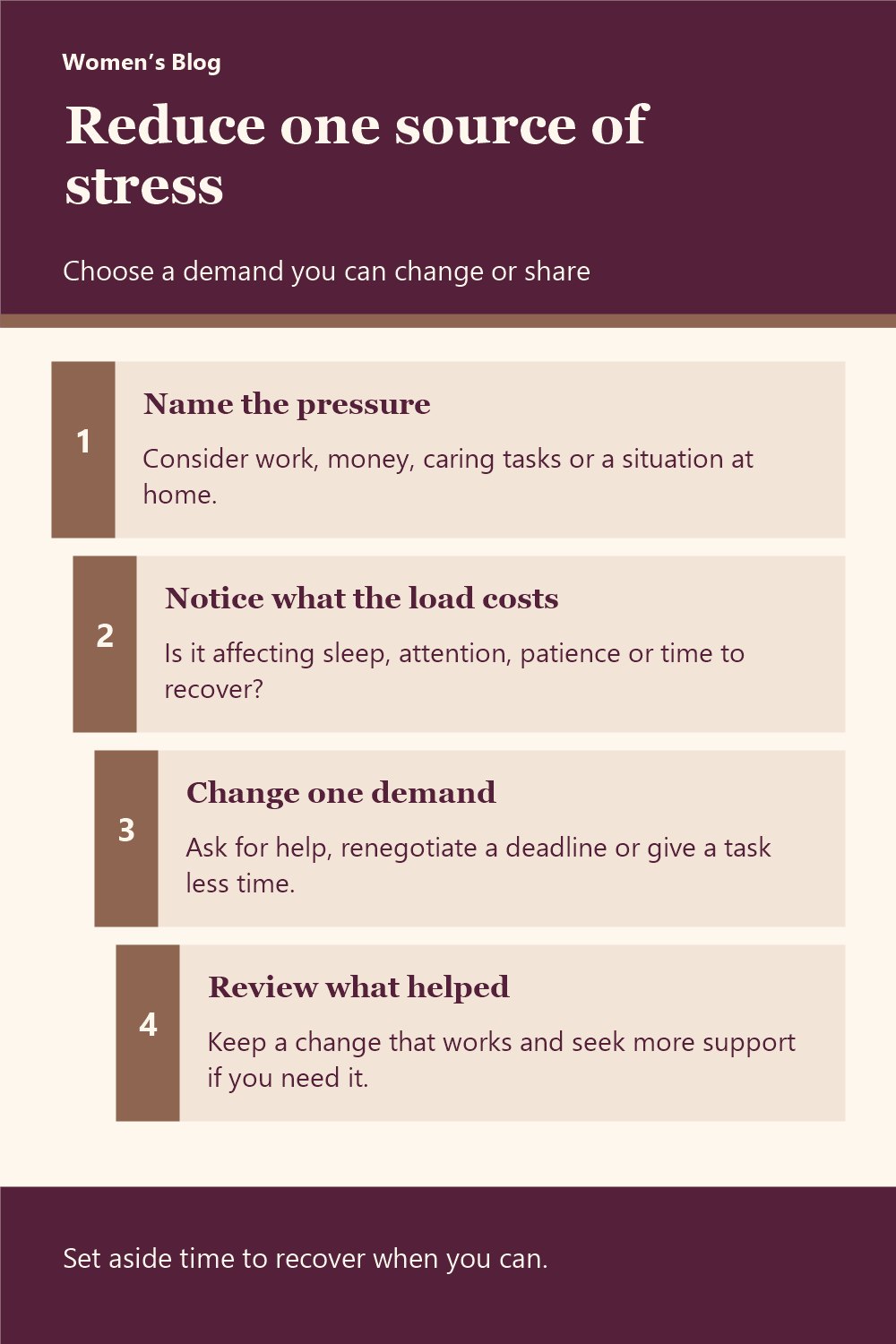
Reduce one source of stress
- Name the pressure Consider work, money, caring tasks or a situation at home.
- Notice what the load costs Is it affecting sleep, attention, patience or time to recover?
- Change one demand Ask for help, renegotiate a deadline or give a task less time.
- Review what helped Keep a change that works and seek more support if you need it.
Set aside time to recover when you can.