

A disappointing date or relationship can leave you questioning your judgement. You may have acted with the information you had, hoped for a different outcome or discovered something you could not know at the beginning.
You can reflect on your own choices without blaming yourself for another person’s dishonesty or unkindness. You do not need to treat every disappointment as a necessary lesson on the way to a guaranteed future partner.
On this page
1. Let the disappointment have some space
You might feel hurt, embarrassed, angry or relieved. More than one feeling can be present. Give yourself time before deciding what the experience means about your future.
Choose a small support that fits today: a familiar activity, a quiet evening, a meal or talking with someone you trust. You do not have to make the situation sound positive to deserve care.
2. Separate a decision from your whole identity
Try a specific description: “I wanted the connection to work, and I stayed after an agreement was repeatedly broken.” That gives you more to consider than “I am terrible at relationships.”
You may identify a choice you would make differently next time. That does not mean you caused someone else’s harmful behavior or should have predicted everything they would do.
3. Notice what you actually know now
Consider what became clear through the experience: a difference in goals, a boundary that matters, a pattern of inconsistency or simply a lack of mutual interest. You can use that information without deciding that either person is fundamentally worthless.
If you do not want to analyse the experience yet, you can leave it for later. Reflection is an option, not a requirement to turn pain into progress.

4. Choose a boundary for contact
Ask whether continued messages, checking social media or seeking another explanation are helping you. You might pause contact, mute an account or give a clear message that you do not want to continue dating.
You do not need another person’s agreement to end a dating connection. If contact includes threats or makes you feel unsafe, seek support that helps you consider your safety and options.
5. Take responsibility where it belongs
If you hurt someone, consider an honest apology and a practical change without expecting forgiveness or renewed contact. If someone hurt you, you do not have to excuse it to care for yourself.
Talking with a trusted person or counsellor may help you separate regret, responsibility and blame. You can ask for a listening ear rather than advice if that is what you need.
6. Decide what you want next at your own pace
You may want a dating break, time with friends, a return to an interest or another chance to meet someone. There is no need to prove that you have recovered by dating immediately.
If you choose to date again, share trust gradually and notice whether interest and respect are mutual. A future connection remains a possibility, while your present needs deserve care whether or not it happens.
Read the infographic in text
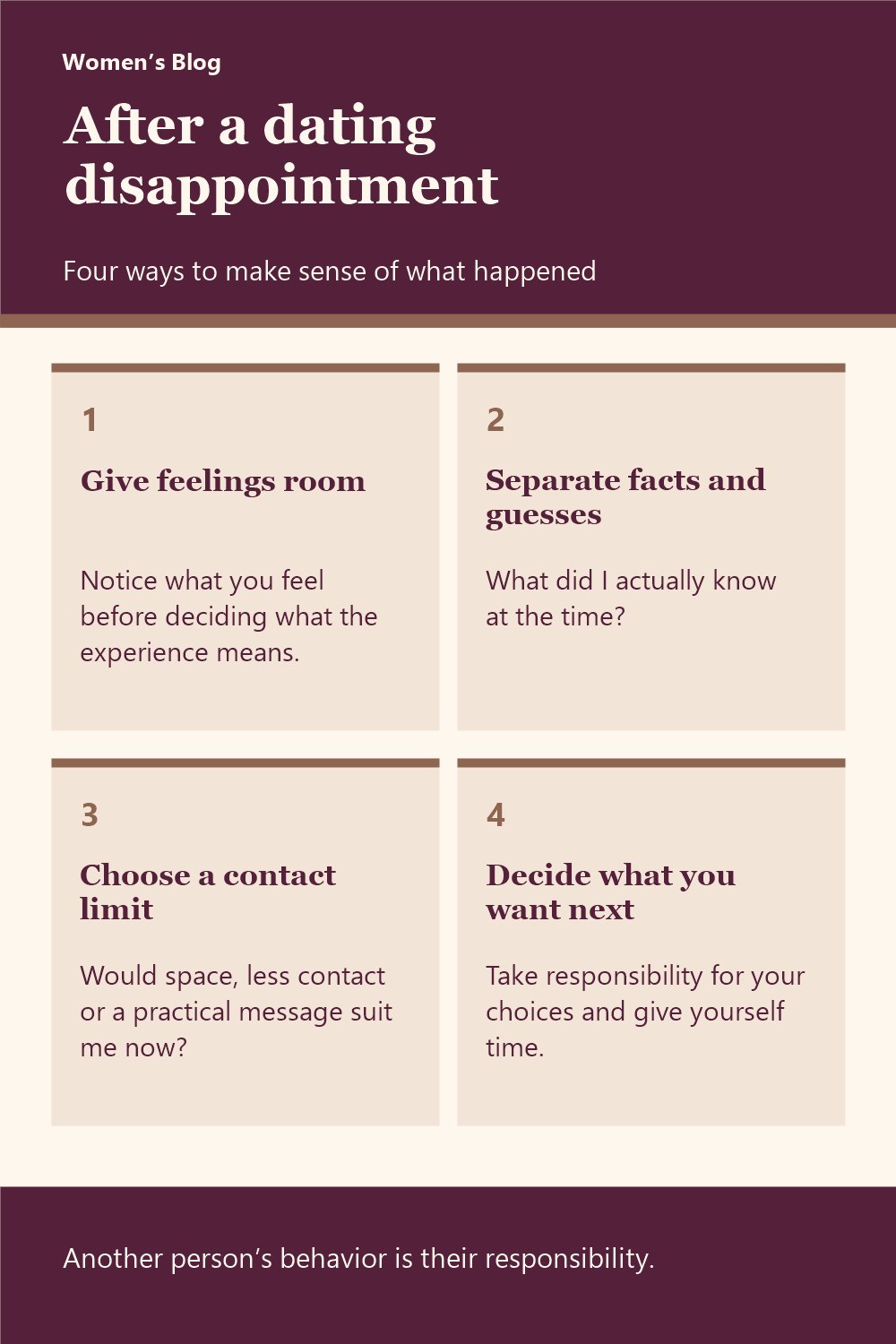
After a dating disappointment
- Give feelings room Notice what you feel before deciding what the experience means.
- Separate facts and guesses What did I actually know at the time?
- Choose a contact limit Would space, less contact or a practical message suit me now?
- Decide what you want next Take responsibility for your choices and give yourself time.
Another person’s behavior is their responsibility.