

Time away can offer room to reconnect, but a trip does not automatically solve relationship difficulties. Different budgets, energy levels and expectations can come along with the luggage.
My husband and I decided to address this by traveling more. This gave us added time and increased the understanding we have for each other, which strengthened our relationship. Now we make it a priority to go on frequent trips together. For us, the trips became a welcome way to reconnect. It brought us closer together and strengthened our bonds.
That is one couple’s experience. Your version might be a nearby afternoon out, an accessible overnight stay or choosing to spend time together at home. Start with what both of you can comfortably manage.
On this page
1. Agree on the purpose of the time away
Do you want rest, exploration, conversation or a break from routine? Name one or two priorities each before booking anything. A quiet holiday and a packed sightseeing schedule are different plans.
Try asking: “What would make this feel worthwhile to you?” Look for an overlap rather than expecting one person to enjoy everything the other chooses.
2. Set a budget you can both accept
Include transport, food, accommodation, access needs, childcare or pet care, and a little room for unexpected costs. Decide who pays for what without assuming that the person who pays more gets more control.
A local outing can be enough. Spending beyond your comfort level to prove your love may add pressure instead of creating time you enjoy.
3. Share the planning work
Divide tasks explicitly: checking routes, arranging bookings, preparing food or gathering documents. Use each person’s abilities and available time without leaving one partner responsible for remembering everything.
Keep important information accessible to both of you. Trust does not require handing over control of your money, documents or ability to leave.

4. Choose a pace that leaves room to rest
Talk about mobility, fatigue, food, sleep and other practical needs. Ask before adding a difficult walk, an early start or an activity that worries your partner. “We can choose something else” is more useful than insisting they should not be afraid.
Leave gaps in the schedule. Quiet time, an unhurried meal or an earlier night can be part of the trip.
5. Make small moments available
You do not need a dramatic setting to enjoy each other. Share a view, have a drink you both like, play a game or notice something new nearby. Put aside distractions for a short period if that suits both of you.
Affection and sex remain optional. Paying for a holiday or planning a romantic evening does not create an obligation.
6. Allow some separate interests
Travelling together does not require doing everything together. Discuss whether one person would enjoy a museum while the other rests, for example. Agree on practical arrangements and a time to meet again.
If someone is ill or needs support, ask what would help and arrange appropriate care. Avoid assuming either that they want to be left alone or that you must cancel every activity regardless of their wishes.
7. Handle disruption without turning on each other
A late train or disappointing room can be frustrating. Address the immediate problem first: food, shelter, a change of plan or time to cool down. Blame and insults do not make a missed connection easier to solve.
Sharing stories can be enjoyable, but travel is not a test of how many private experiences someone will disclose. Respect a wish to keep a subject personal.
8. Bring one useful habit home
Afterwards, ask what each of you enjoyed and what you would change. Perhaps you liked a short evening walk, eating without screens or sharing decisions more clearly.
Choose one realistic habit to try at home. If important disagreements remain, discuss them directly rather than relying on another trip to resolve them. A relationship needs respect and care on ordinary days too.
Read the infographic in text
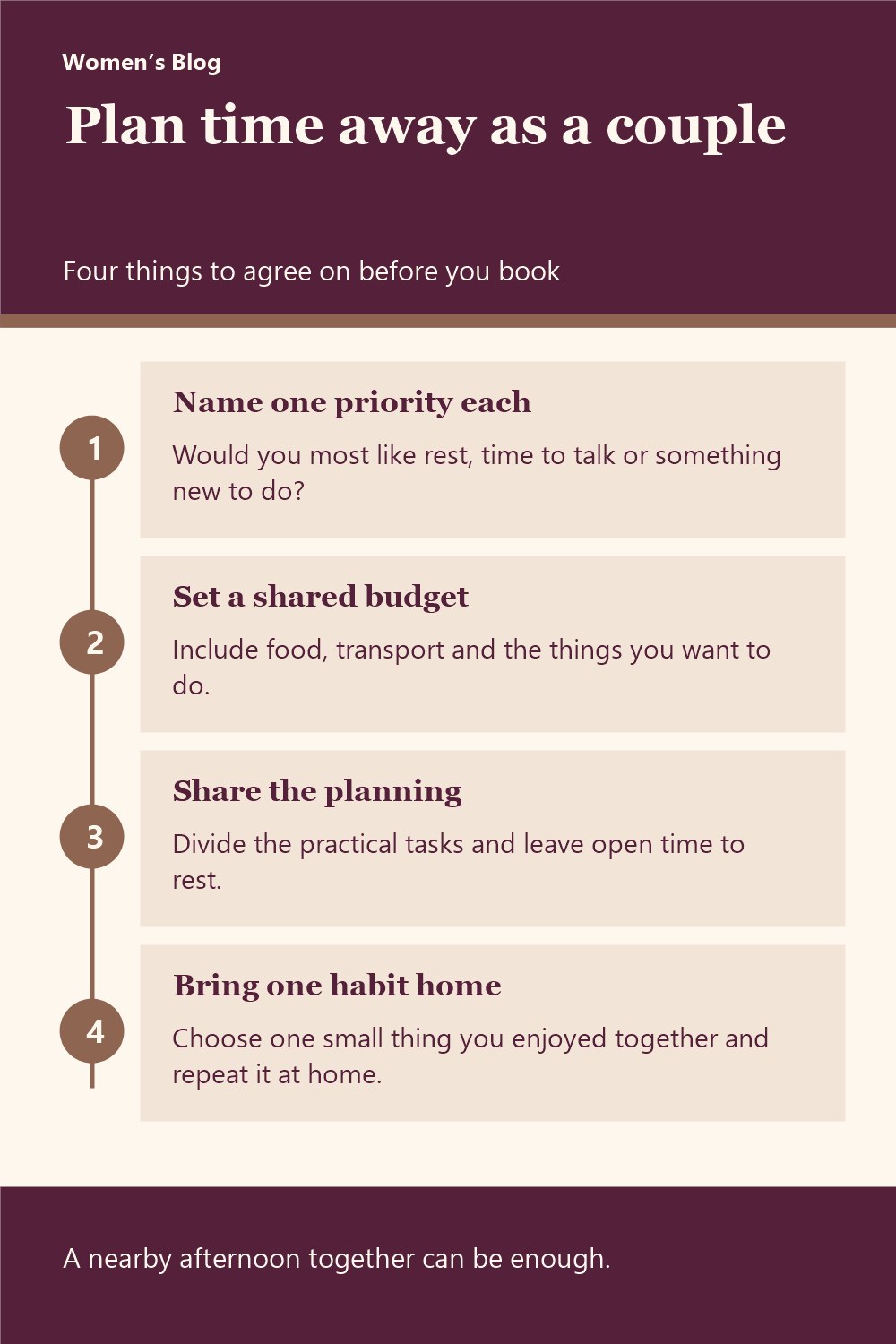
Plan time away as a couple
- Name one priority each Would you most like rest, time to talk or something new to do?
- Set a shared budget Include food, transport and the things you want to do.
- Share the planning Divide the practical tasks and leave open time to rest.
- Bring one habit home Choose one small thing you enjoyed together and repeat it at home.
A nearby afternoon together can be enough.