

Jealousy can arise in a relationship, friendship or moment of comparison. Feeling it does not prove that someone has betrayed you, and it does not make you a bad person. What matters is how you understand the situation and treat yourself and other people.
You can take a feeling seriously without treating it as an instruction to check a phone, make an accusation or compete for someone’s attention. These steps offer ways to pause and decide what would be useful.
On this page
1. Look at the relationship and the facts
Ask what happened, what you know directly and what you are assuming. A partner arriving late is an observation; deciding they no longer care is an interpretation. A repeated broken agreement is also relevant information and deserves attention.
Jealousy can happen in a caring relationship. It can also follow dishonesty or uncertainty. You do not need to diagnose an attachment style or blame your childhood to notice what is happening now.
2. Find support that helps you think clearly
Talk with someone who can listen without feeding suspicion or dismissing you. You might ask, “Can you help me separate what I know from what I am afraid of?” A counsellor may be helpful if jealousy repeatedly disrupts your relationships or daily life.
If a partner uses jealousy to justify threats, monitoring, isolation or demands for passwords, prioritise your safety. The National Domestic Violence Hotline’s relationship guide explains the difference between healthy boundaries and control.
3. Recognise the feeling without shaming yourself
Try naming the experience: “I feel left out,” “I am afraid of losing this relationship,” or “Their success reminds me of something I want.” Naming a feeling can make the next decision more specific than calling yourself irrational or inadequate.
4. Learn what triggered the reaction
Notice the setting. Was there an actual breach of trust, an unclear agreement, an old hurt, a competitive situation or a social media post showing only part of someone’s life? More than one explanation may fit.
If comparison keeps upsetting you, experiment with muting an account or taking a break. Keep the change small enough to notice whether it helps, rather than turning it into another test of willpower.
5. Let the feeling pass without forcing it away
You do not have to settle everything at the peak of the reaction. Step away from a heated exchange if it is safe, put down the phone or spend a few minutes on an ordinary activity. A pause gives you time to choose a response; it does not erase a genuine concern.

6. Discuss a specific concern respectfully
When it feels safe to talk, describe the event and ask a clear question: “We agreed to let each other know when plans changed. That did not happen yesterday. Can we talk about what to do next time?” Listen to the answer and consider whether actions match it.
A boundary describes what you need and what you will do. It does not give either person ownership of the other’s friendships, clothing or private messages. You can decide that a relationship does not meet your needs without trying to control someone into changing.
7. Build a life that includes your own priorities
Make room for friendships, interests and goals that matter to you, within your time and resources. Someone else’s relationship or achievement is not a complete measure of your worth. Choose one activity that reconnects you with your own life today.
Read the infographic in text
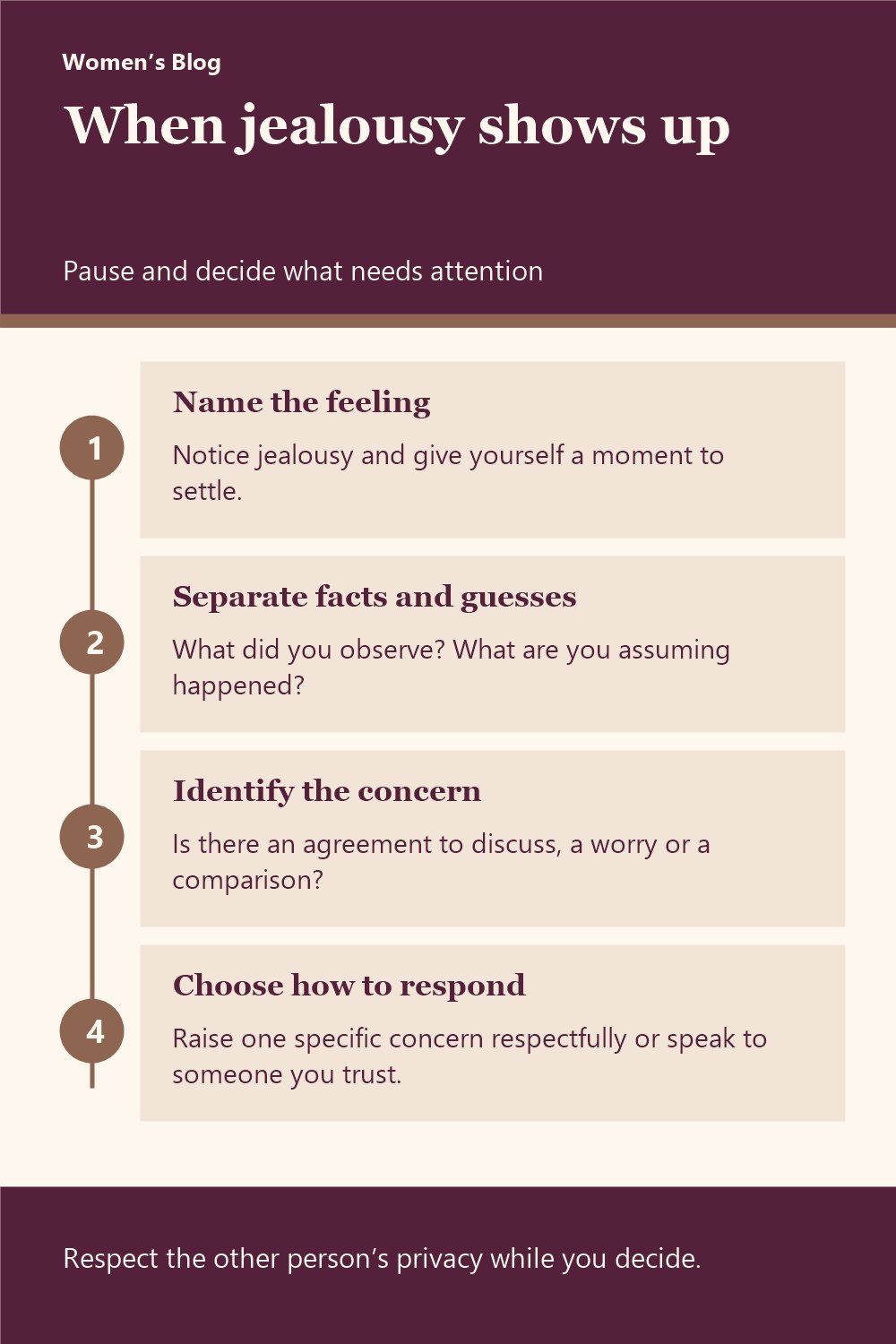
When jealousy shows up
- Name the feeling Notice jealousy and give yourself a moment to settle.
- Separate facts and guesses What did you observe? What are you assuming happened?
- Identify the concern Is there an agreement to discuss, a worry or a comparison?
- Choose how to respond Raise one specific concern respectfully or speak to someone you trust.
Respect the other person’s privacy while you decide.