

You may feel comfortable in one part of life and uncertain in another. Speaking up, starting something unfamiliar or returning after a difficult experience can all bring self-doubt. That does not make your feelings your fault or mean you need to become a different person.
Choose one situation in which you would like more confidence. Then consider a fairer expectation, a manageable opportunity to practise and the support that would make it easier. You do not have to feel certain before taking a small step.
On this page
Name the situation you want to handle
Make the goal specific enough to recognise. “Be confident” can mean almost anything. “Ask a question at the class I want to join” or “Explain that I cannot take on another task” gives you something clearer to prepare for.
Ask why the step matters to you. You might want access to an interest, a clearer boundary or more independence in an everyday activity. A goal does not have to impress anyone else to be worth trying.
Notice the conditions that affect the situation. Missing information, an inaccessible setting, discrimination or an unreasonable demand cannot always be solved by feeling more positive. You may need an adjustment, practical help or a different arrangement.
Give yourself a fairer expectation
Write down what you are expecting of yourself. Are you requiring a perfect answer, no visible nerves or immediate success at something new? Consider what would be reasonable for someone learning under the same circumstances.
Separate one difficulty from an overall judgment. “I did not understand those instructions” gives you a problem to clarify. “I am bad at everything” reaches far beyond the information available. A fairer response might be: “I can ask for an example before trying again.”
The NHS’s guidance on low self-esteem includes examining harsh beliefs and treating yourself with kindness. You do not need to invent positive facts or deny something painful. Aim for a description that leaves room for your abilities, limits and circumstances.
Try a supported, manageable practice
Choose a smaller version of the task you want to attempt. Before joining a class, you might ask the organiser how a session works. Before explaining a boundary, you could write down the main sentence or practise with someone you trust.
Support is part of the plan, not evidence that you lack confidence. You may communicate better with notes, extra preparation, an accessible venue or a different way to ask a question. There is no required posture, smile or amount of eye contact.
Decide what would count as trying this step. Sending the question or stating your availability is within your influence; another person’s approval is not. You can learn something useful even if the answer is disappointing.
You do not need to make every task harder as soon as you complete it. Repeat what helps, reduce the size of the next step or pause when another need takes priority. Practice should serve a goal you choose.

Separate useful feedback from disrespect
Useful feedback points to something you can understand: a missing detail, a different method or an expectation that needs clarifying. If a comment is vague, you can ask, “Which part would you like me to change?” You do not have to accept a broad insult as an accurate assessment.
If someone regularly ridicules you, the answer is not simply to become confident enough to tolerate it. Consider a boundary, another source of support or an appropriate way to raise the problem. You may have limited choices about contact with family or colleagues; work with the options actually available to you.
A trusted person’s encouragement can help, but you do not need everyone to approve of your choices. Equally, confidence does not require ignoring other people’s needs. You can be clear about what you want while listening and respecting another person’s right to decline.
Review what helped and find support
After an attempt, ask three practical questions: What did I do? What helped me participate? What would I adjust next time? This can be more useful than deciding whether you looked confident enough.
If the step did not go as hoped, consider the information it gave you. You may need clearer instructions, more time, a smaller task or a different person to ask. A setback does not measure your value, and you do not need to turn it into a demand to be grateful.
If self-doubt is persistent, distressing or affecting daily life, consider speaking with a qualified professional or trusted support person. You do not have to prove that you tried every self-help idea first. Getting support can be one of the choices you make for yourself.
Read the infographic in text
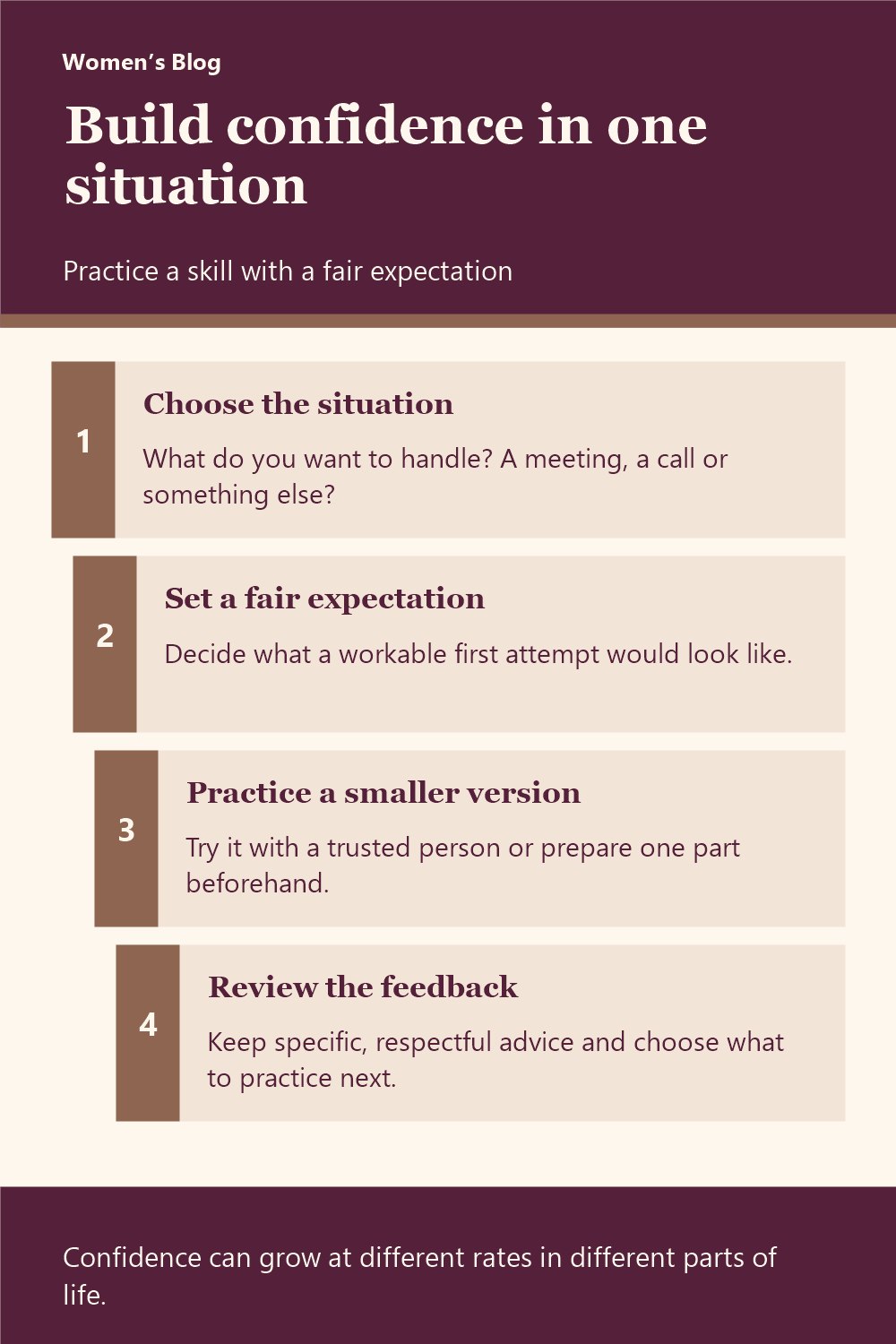
Build confidence in one situation
- Choose the situation What do you want to handle? A meeting, a call or something else?
- Set a fair expectation Decide what a workable first attempt would look like.
- Practice a smaller version Try it with a trusted person or prepare one part beforehand.
- Review the feedback Keep specific, respectful advice and choose what to practice next.
Confidence can grow at different rates in different parts of life.