

Everyday enjoyment can come from interest, companionship, comfort or the satisfaction of doing something that matters to you. What suits you may change with your health, responsibilities, resources and stage of life.
Use these fifteen ideas as possibilities to explore. Try one that appeals to you, then notice whether you would like to repeat or adapt it.
On this page
- Notice what you are missing
- Allow a mixture of feelings
- Choose a small experiment
- Update an old favourite
- Look at the conditions
- Make room for a real problem
- Keep care practical
- Try interest before intensity
- Separate choices from outcomes
- Decide what good enough looks like
- Let attention settle
- Choose the kind of connection you want
- Notice one detail
- Remember what was worth repeating
- Review gently and seek support when needed
1. Notice what you are missing
Rather than looking for the exact day your happiness disappeared, ask what is absent now. Is it companionship, interest, rest, freedom or something else? You may not know the reason immediately. A short note about one difficult situation can be enough to begin.
2. Allow a mixture of feelings
Enjoyment can sit alongside grief, worry or disappointment. You do not have to settle those feelings before accepting a pleasant invitation or noticing something beautiful. Equally, an enjoyable moment does not mean that a loss has stopped mattering to you.
3. Choose a small experiment
Pick an activity you are curious about and decide how much time or money you can comfortably give it. For example, borrow a book before buying a course. You are gathering information about what suits you; there is no requirement to enjoy the experiment.
4. Update an old favourite
Consider which part of an activity you once liked. You might still enjoy music while preferring a smaller venue, or like making art without joining a class. Adapt the setting, company, pace or length to your present interests and capacity.
5. Look at the conditions
An outing may feel different when you are hungry, tired, uncomfortable or under time pressure. Notice those conditions before concluding that you no longer enjoy anything. A shorter visit, an accessible route or a different time of day may make the experience more workable.
6. Make room for a real problem
Some barriers need action: an unresolved conflict, a financial deadline or too much work. Write down the issue and one possible next step. You can also ask someone appropriate to help. Enjoyment does not require pretending those problems are unimportant.
7. Keep care practical
Choose a supportive routine you can repeat without turning it into another demanding project. A regular meal, a comfortable place to rest or a check-in with a friend may fit. The Self Help Cafe self-care guide offers more everyday options.
8. Try interest before intensity
You do not have to feel excited for an activity to deserve a place in your life. Something can be mildly interesting, satisfying or companionable. Notice those quieter responses rather than searching for a dramatic change in mood or a particular brain-chemical effect.
9. Separate choices from outcomes
You can choose to make an invitation or practise a skill; you cannot guarantee another person’s answer or an immediate result. Decide what action belongs to you, what you need to ask and when you will review the situation. Leave room to change direction.
10. Decide what good enough looks like
For a low-stakes activity, choose a modest stopping point. A simple meal, a short visit or a finished first attempt can be worthwhile. If you notice yourself repeatedly improving something after you stopped enjoying it, consider whether that extra effort serves a purpose.
11. Let attention settle
Try an activity with a clear, manageable task: arranging flowers, working on a puzzle, reading or preparing something simple. You may become absorbed, or you may not. Keep the time and effort proportionate so that the activity remains an option you can choose freely.
12. Choose the kind of connection you want
Company can mean a familiar friend, a shared-interest group or a brief exchange with someone you know. Consider whether you want conversation, a shared task or quiet presence. Respect the other person’s availability and your own need for time alone.
13. Notice one detail
For a moment, attend to something ordinary: a sound, a colour, the texture of a cup or the view from a window. You can use this as a pause without asking it to erase difficult thoughts. Stop or try something else if the exercise feels uncomfortable.
14. Remember what was worth repeating
After an activity, ask one or two questions: What did I like? What would make it easier next time? You can note a sentence or simply remember the answer. Avoid turning enjoyment into a score that you must improve every day.
15. Review gently and seek support when needed
Choose one thing to repeat, adapt or leave behind. Connection, activity and learning are among the options in the NHS guide to mental wellbeing. If you are persistently losing interest in things or struggling to cope, ask a qualified health professional for support; the NHS low-mood guide explains when further help is appropriate.
Read the infographic in text
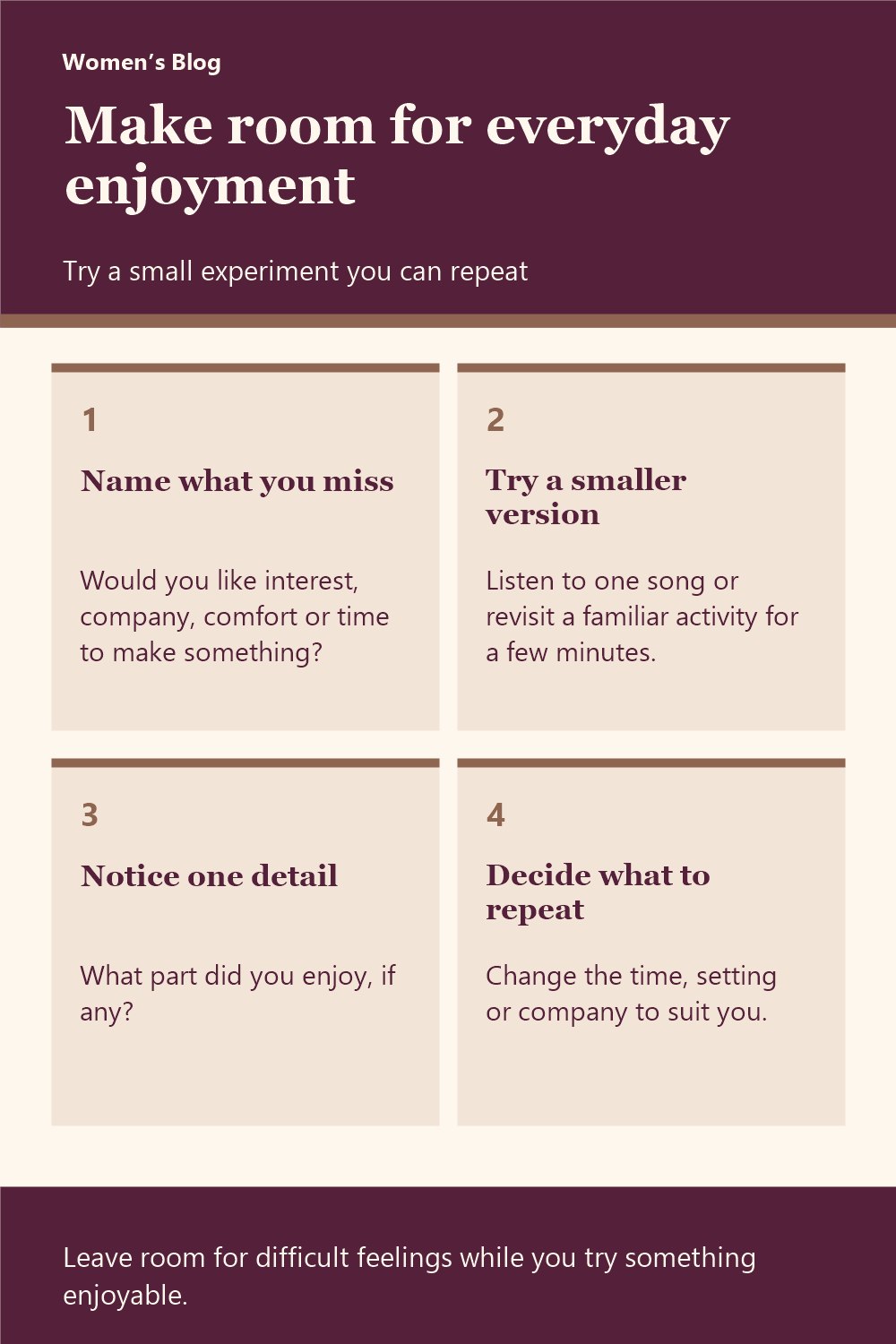
Make room for everyday enjoyment
- Name what you miss Would you like interest, company, comfort or time to make something?
- Try a smaller version Listen to one song or revisit a familiar activity for a few minutes.
- Notice one detail What part did you enjoy, if any?
- Decide what to repeat Change the time, setting or company to suit you.
Leave room for difficult feelings while you try something enjoyable.