

Empathy involves making an effort to understand another person’s experience and responding with consideration. It can be part of a conversation with a friend, a disagreement with a partner or a moment when someone needs practical help.
Some people use the word “empath” to describe feeling especially sensitive to other people’s moods. If that word is meaningful to you, you can use it while also checking your impressions, respecting privacy and making room for your own needs.
On this page
Check your impressions
You might notice a quiet voice, a change in expression or a person spending more time alone. Those observations can be a reason to check in. They do not tell you the whole story of what someone is feeling or why.
Try an invitation that leaves room for correction: “You seem quieter today. Would you like to talk?” If the person says they are tired or prefer some space, take that answer seriously. They do not have to disclose something private to confirm your impression.
Strong feelings of your own also deserve attention. A conversation might remind you of a difficult experience or leave you feeling unsettled. You can notice that response without deciding that you know precisely what belongs to the other person.

Make room for the person to speak
Ask whether now is a workable time for a conversation. A quiet setting, a phone call or a written exchange may suit different people. Consider distractions, accessibility and whether either of you needs to finish something first.
Once someone starts talking, give them room to complete the thought. Ask about the part you have not understood: “What was that meeting like for you?” is more open than telling them how they must have felt.
If you are unsure what sort of response they want, ask. They might want company, help thinking through a decision or a chance to speak without advice. You can say what you are able to offer rather than agreeing to a role you cannot manage.
The CDC’s guide to listening and supporting someone offers further conversation ideas. You can use suggestions that fit the person and the situation without turning the conversation into a script.
Respond to what you have heard
Refer to the experience the person described. If they are disappointed about a cancelled plan, you might say: “You were looking forward to that, and now you have to change your day.” Leave room for them to tell you if you have misunderstood.
Be careful with promises about how everything will turn out. You can offer something specific instead: help writing a message, company while they wait or a check-in at a time you can keep. Ask before taking action on their behalf.
You can understand why someone feels upset while disagreeing with something they did. For example: “I can see that the argument hurt. I am not comfortable passing on that private message.” Consideration can include a clear limit.
If you get the response wrong, acknowledge it and adjust. “I jumped into advice before hearing you out. Would you like to continue?” gives the other person a choice about what happens next.
Keep limits around time and privacy
Before a difficult conversation, consider how much time and attention you have. You might say: “I have time to talk until six, then I need to leave.” If you cannot listen now, offer another time only when you expect to be available.
Keep personal stories private. Ask before discussing them with someone else, sharing a screenshot or using a friend’s experience as an example. Someone choosing to confide in you is not an invitation to investigate the rest of their life.
You can care about a person without being their only source of support. If they need something beyond what you can offer, discuss other options without making commitments for them. They retain their own choices, and you retain your limits.
Include your own needs in the picture
After a demanding conversation, notice what would help you return to your day. You might need quiet, a meal, an ordinary task or time with someone whose company you enjoy. Choose what fits rather than treating any activity as a required routine for sensitive people.
Being considerate does not require a particular personality, a partner or children. You can express care through listening, respecting a no, making a practical offer or giving someone space.
If conversations repeatedly leave you unable to manage your own day, reconsider the arrangement and seek support for yourself if needed. You can take someone else’s experience seriously while keeping a life, preferences and sources of support of your own.
Read the infographic in text
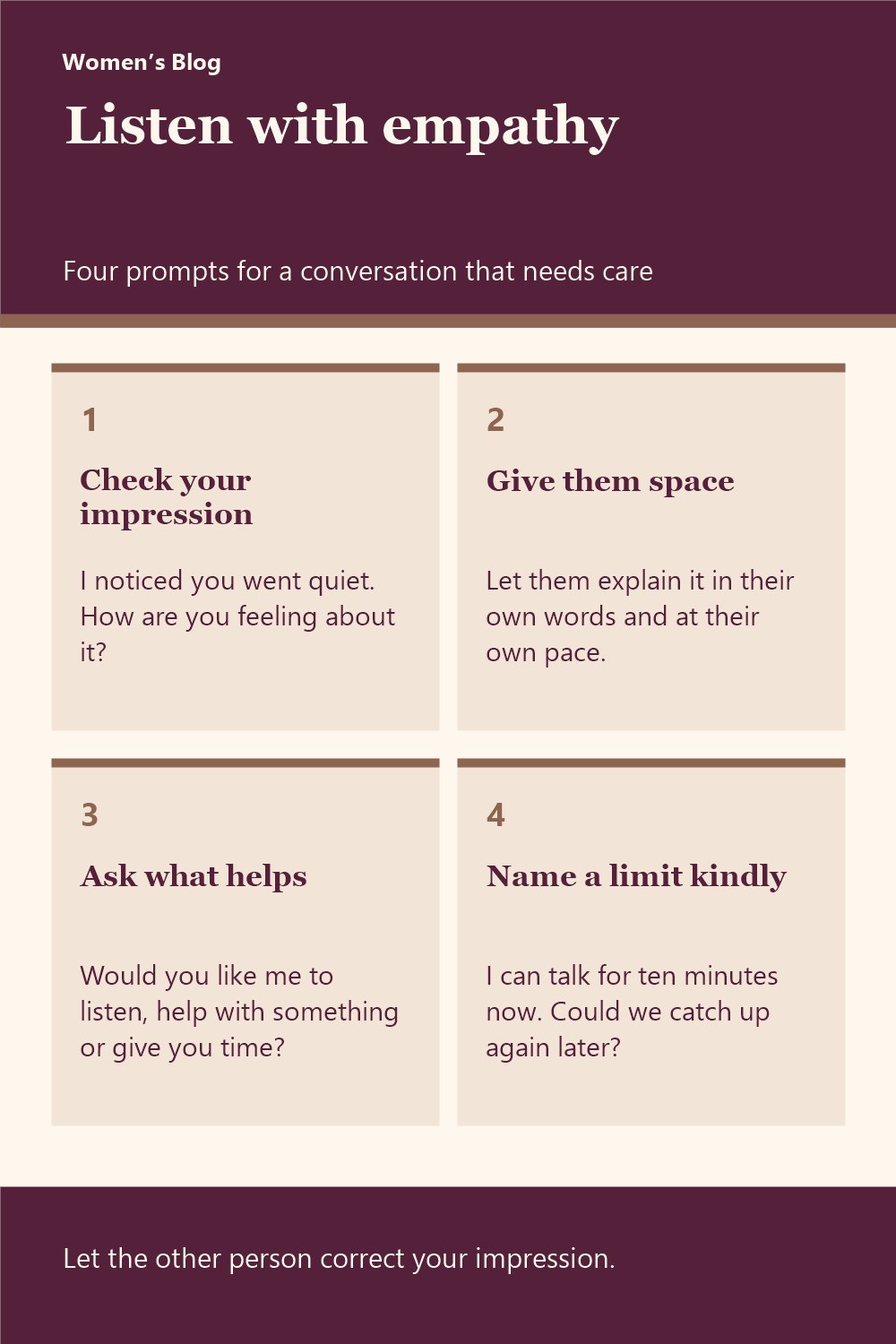
Listen with empathy
- Check your impression I noticed you went quiet. How are you feeling about it?
- Give them space Let them explain it in their own words and at their own pace.
- Ask what helps Would you like me to listen, help with something or give you time?
- Name a limit kindly I can talk for ten minutes now. Could we catch up again later?
Let the other person correct your impression.