

You may want to pause before replying to a difficult message, spend less time checking updates or begin a task you keep putting off. “Have more self-control” names an intention, but it does not tell you what to do at the moment the choice appears.
A more useful starting point is one action, the situation around it and a plan you can adjust. You can take responsibility for your choices while recognising tiredness, competing demands and the support you need. Progress does not require controlling every thought or feeling.
On this page
1. Choose one action to work on
Replace a broad aim such as “be more disciplined” with something you can describe. Perhaps you want to finish a short piece of writing before opening a social app, or leave a nonurgent message as a draft until you have checked what you want to say.
Ask why this particular change matters to you. Is it about having fewer interruptions, communicating more clearly or making room for something you enjoy? Your reason can be ordinary. It does not need to prove that you are becoming a better person.
Choose an action within your influence. You can decide when to check a message, but you cannot make someone answer kindly. You can prepare for a task without guaranteeing its result.
2. Notice the situation around it
Think about a recent example. What were you doing just before the action? Were you waiting, uncertain how to begin or responding to an alert? Describe the sequence without turning it into a judgment about your character.
For example: “I opened my notes, saw how much there was to do and picked up my phone.” That suggests a different next step from “I always ruin everything.” You might need a clearer first task or somewhere to put questions you cannot answer yet.
Consider the setting too. Interruptions, confusing instructions, a crowded workspace or someone else’s expectations may be part of the difficulty. Look for something that can change around you rather than asking yourself to resist the same obstacle repeatedly.
3. Make the next step easier
Prepare what you need for the action you want to take. Open the right document, put the materials together or write a single instruction for where to start. “Write the opening sentence” may be more workable than “finish the entire project.”
A difficult task may also reveal an unmet need. Pain, illness, disability and needing assistance are not failures of self-control. If the demand is beyond your current capacity, consider a smaller version, an adjustment or help with it.
The NHS guide to tackling tasks suggests reminders, brief starting periods and considering a suitable time and place. Choose ideas that fit your circumstances. A timer can be optional, and stopping after a short attempt is allowed.
Keep the aim focused on making an action possible. You do not have to feel highly motivated or completely ready before trying a manageable part.

4. Give a pause a practical purpose
A pause is most useful when you know what comes next. Before sending a tense message, you could save it, step away briefly and return to check the request you are making. There is no need to erase your anger before deciding how to respond.
For unwanted checking, try changing one cue: silence a nonessential app alert or place the phone somewhere you have chosen while doing a short task. Keep access to calls, caring responsibilities and accessibility tools you rely on. The arrangement should help your life work.
Try a clear sentence: “When I reach for updates during this task, I will note the question I am avoiding and choose one next step.” If the plan adds pressure or creates another problem, change it.
5. Plan for a demanding day
Decide what a smaller version would look like before the day becomes crowded. If a full session is unrealistic, you might organise the materials, write a few lines or ask for the information needed to continue.
Name a likely obstacle and one response. “If I am interrupted, I will leave a note showing where to resume.” “If the task is unclear, I will send a specific question.” Planning for an interruption is different from promising it will never happen.
Avoid giving every available hour to improvement. Necessary responsibilities, care, rest and enjoyment all need room. Sometimes the useful change is reducing a demand or sharing work. Learn to Take Care of You offers examples of identifying those needs.
6. Review what happened fairly
After trying the plan, look at the actual sequence. Did the reminder appear when you needed it? Was the first step clear? Did the pause help you make a more deliberate choice, or did you need a different arrangement?
A missed attempt can point to something to adjust. If you checked the app anyway, perhaps it was already open on the device needed for your work. You could close that tab, choose a separate workspace or shorten the task. One result does not describe your whole ability.
If your action affected someone else, include appropriate repair. Explain, correct what you can and reconsider the plan. Self-kindness and responsibility can go together; repeated self-punishment does not complete either job.
7. Include support and workable limits
Ask for help with the specific difficulty: clearer instructions, fewer interruptions, company while starting or an agreed division of tasks. Another person can support your plan without monitoring every choice or shaming you after a setback.
If a repeated behaviour worries you or is affecting your health, safety or daily life, consider appropriate professional support. You do not have to demonstrate perfect willpower before asking. Use Self-Kindness in Everyday Life: Boundaries, Care and Room to Be Human for further reflection on care and limits.
Choose one action to try, one adjustment that makes it easier and a point when you will reconsider. Let what happens guide the next version of the plan. The aim is a more workable choice in your actual circumstances.
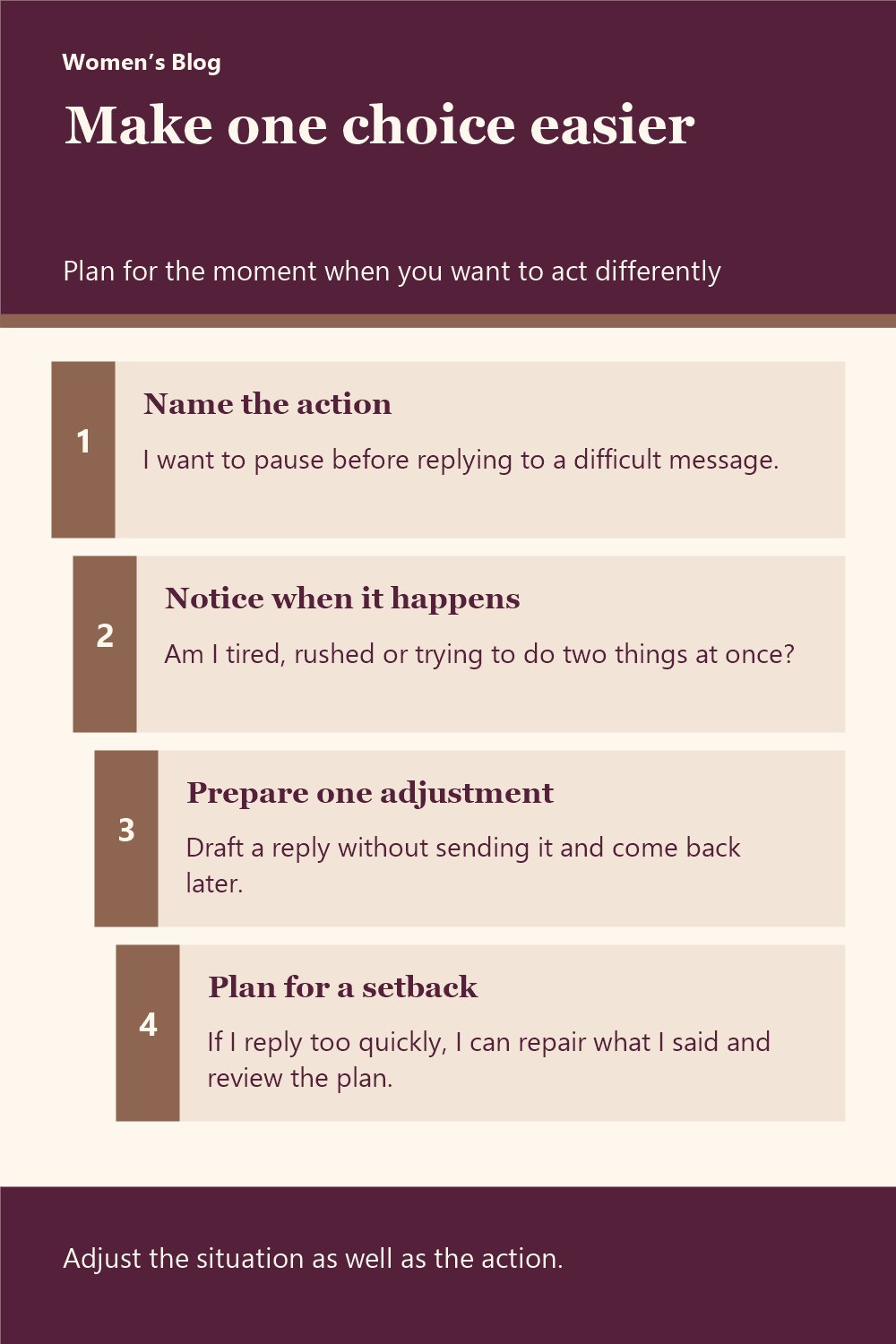
Read the infographic in text
Make one choice easier
- Name the action I want to pause before replying to a difficult message.
- Notice when it happens Am I tired, rushed or trying to do two things at once?
- Prepare one adjustment Draft a reply without sending it and come back later.
- Plan for a setback If I reply too quickly, I can repair what I said and review the plan.
Adjust the situation as well as the action.