

Care in a relationship can make life easier when both people have a choice about what they offer and accept. Discuss the form of help, any expectations, and what you each want to keep deciding for yourselves.
Ask what care means to each of you
You might think of care as affection, help, emotional attention, or financial generosity. Your partner might use the same word for different actions. Look at examples instead of thinking a broad explanation would be more caring. You could say something like, “It helps me when you make dinner and I work a late shift.” This is easier to talk about than saying, “You should know what I need without me telling you.”
You can name something that doesn’t feel helpful. A surprise plan might be exciting for one person and create stress for another who needs notice. Your preference is information, but it’s not a rejection of the relationship. Talking about care together can remove the pressure to feel thankful for an offer that doesn’t fit your life. It also gives the other person a chance to give you support that you can use.
Keep a real choice about the offer
A kind offer allows room for an answer. You could say something like, “Would you like me to come with you?” This is different than saying that you’re not going to attend an appointment on your own.
According to the love is respect guide to boundaries and expectations it emphasizes discussing limits and avoiding pressure to change them. That principle applies even when an action is described as protection or generosity.
Pay attention to what happens when you say something like, “Thank you, but I want something different.” Your partner might be disappointed but still respects your decision. If they try to guilt you, put you down, or punish you, then this is a different thing entirely. You don’t have to judge every offer on its own, but you should have room to respond to what matters.
Talk about expectations before accepting
You can say thank you without agreeing to something that’s not related. A paid bill, a gift, or a good conversation doesn’t mean permission for them to access your body, accounts, or private information.
According to the love is respect resource on physical boundaries it explains that sex is not owed. Consent remains a separate, freely made choice.
This can work for small decisions too. If someone buys you dinner, it doesn’t mean they get to decide if you go on another date. If a partner helps you while you’re sick, it doesn’t mean they have control over your schedule. If the expectations are attached to an offer, they need to be talked about before being agreed upon. Some things might not work in your life at all, and that’s okay. Being thankful can be nice and sincere, but the choice should stay yours.
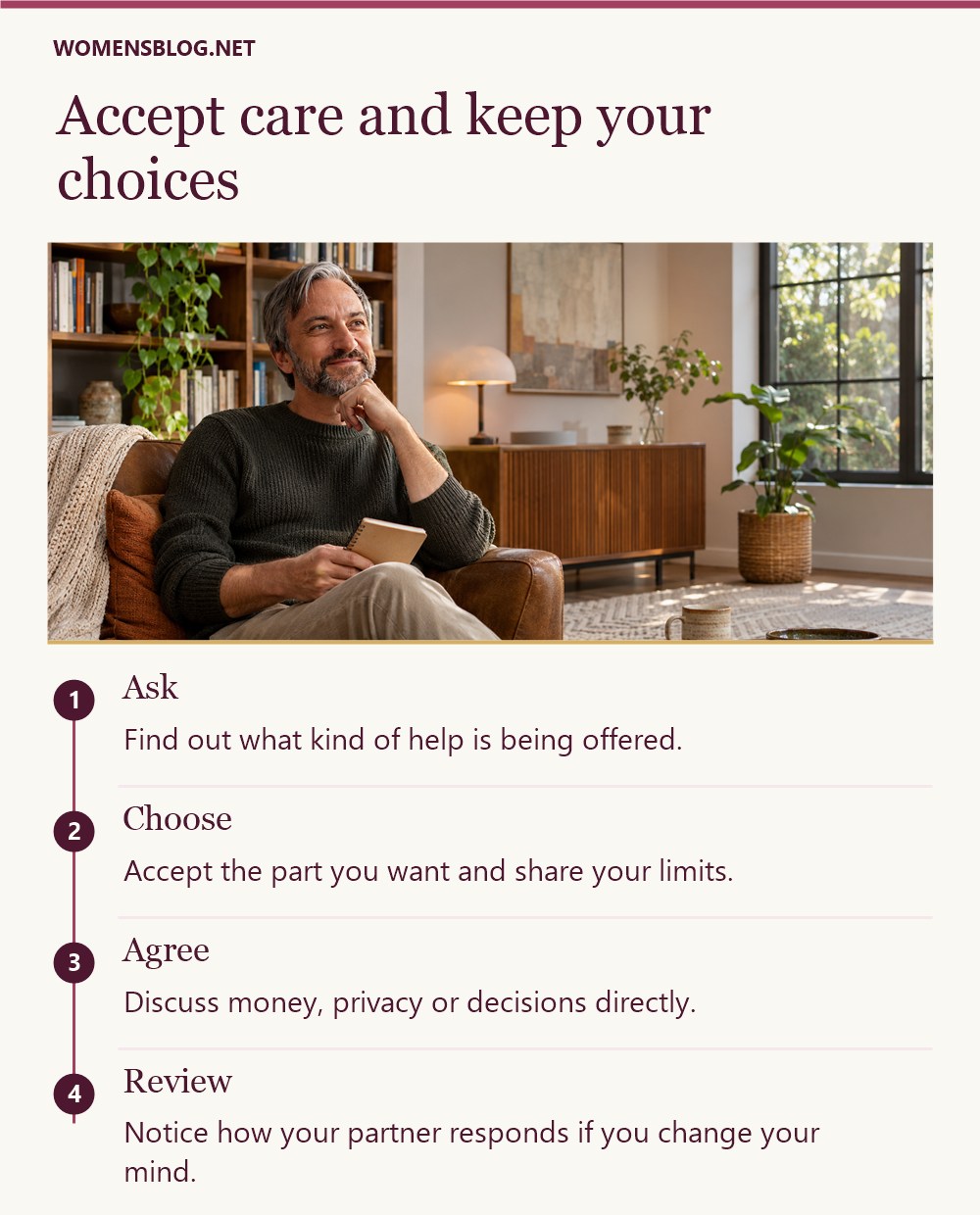
Read the visual guide as text
- Ask. Find out what kind of help is being offered.
- Choose. Accept the part you want and share your limits.
- Agree. Discuss money, privacy or decisions directly.
- Review. Notice how your partner responds if you change your mind.
Ask for the help you would actually use
Being vague about what kind of help you need can leave you doing all the planning, reminders, and fixing things if they don’t work out. Say what is included and what parts you want to do.
You might say something like, “Can you handle the grocery shopping, which means looking at the list and putting the food away. I’ll pick the ingredients that are needed for my own diet.” Another person might want to share the planning differently, and you can make it fit your own situation.
Don’t just think that someone is going to want you to direct each detail. You can ask someone to do something for you, with there still being boundaries. The difference is whether the arrangement is picked and understood. If the results meet your needs, then doing it can be fine. If it ignores your limits or your health needs, go back to the agreement instead of saying that any kind of help is good enough just because someone was nice enough to offer.
Decide together about shared matters
Some choices that are made affect everyone, such as housing, bills, or caregiving. Others concern your own body, friendships, or your personal information. Care shouldn’t make these lines cross for every person making a decision.
You can ask something like, “What were we deciding together, and what belongs to both of us?” You might need to talk about your budget but still keep your personal choices and access to information.
Keep access to important practical resources
Financial help will reduce pressure, but it needs to have clear terms. Is it a loan, a gift, a shared expense, or something they’re going to keep giving you? What happens if the situation changes?
For big decisions, look at the appropriate advice instead of agreeing on a romantic situation or listening to a description of trust. You need to understand what the debt is going to cost and how it’s going to be paid off.
Keep records for your own information. A plan that only works while one partner talks about everything can leave the other person vulnerable if they’re not available or don’t want to do something. Being transparent can make getting help more comfortable. This helps you to understand the arrangement and then to agree or disagree with it without having to do everything on your own.
Talk about privacy
Closeness doesn’t mean access to devices, passwords, medical records, or conversations that you have with your friends. You’re the one that gets to choose what you share with other people.
Talk about the practical needs behind your request. Your partner might need to have an emergency contact number without needing your entire history. Someone who goes to an appointment with you can be there for you without knowing about your doctor’s visit.
Don’t treat privacy as disloyalty. At the same time, it’s important to be honest about things you agreed to. A relationship where information is shared with consent can be good, but it shouldn’t ever be pushed with pressure or secret monitoring. You can still want emotional openness but keep a private space for personal reflection and support.
Notice what happens when you say no
Setting a small boundary can show how an arrangement deals with a choice. You might say no to a gift, change the restaurant you go to, or say you want to spend your evening with a friend. Look at the patterns, and don’t try to do a secret test.
Does your partner listen to what you say, negotiate when needed, and respect the choice that you make? Are they allowed to express their own feelings without making you feel responsible for taking away every disappointment?
Even if your first response isn’t perfect, it’s something you can talk about. If there are threats, financial restriction, isolation, or punishment, this is more serious. If you feel unsafe, get support. Use a safe device or a different contact route when you need to. You don’t have to comfort a person to prove that your concern is valid or to follow a certain way of communicating if there’s a risk.
Check whether the arrangement still fits
After you get help, ask what changed, such as: Did the test become easier? Did you get to rest, and did you get the support you needed?
When you’re specific about the observation, you can talk about it. You could say something like, “I appreciated the meals. Getting the delivery coordinated each day took a lot more time than I thought it would. Could we pick two days in advance?” That allows you to talk about what worked and then fix what didn’t.
You can stop an arrangement if they no longer fit. Give notice if other people depend on your plan, but don’t just think that if you commit once, it means you have to do it forever. Consent to help can be looked at again, just like other agreements. Reviewing them is a way to be responsive instead of allowing something nice to become a rigid system you have to keep.
If a partner controls your access to money or pressures you to hand over passwords, consider seeking confidential support. The National Domestic Violence Hotline’s overview of abuse describes financial and technology-related control.
Related reading. Feminine Energy in Dating: A Personal Lens, Not a Rulebook.
Frequently asked questions
1. Can I accept only part of an offer?
Yes. Say which part would help and what you prefer to handle yourself. Ask whether that version works for your partner too.
2. Do I owe my partner a decision because they helped me?
You can appreciate help and make your own decisions. Discuss any expectations attached to an offer before you agree.
3. How can I ask for support without handing over the decision?
Name the help you want. For example, ask your partner to listen while you compare options and say that you’ll choose the next step yourself.
4. What if we share costs?
Talk openly about the amount, who pays and whether repayment is expected. Keep both people’s access to essential information and agreed resources in mind.
5. What if I feel pressured to say yes?
Take time to think and consider getting support from someone you trust. If declining feels unsafe, a confidential support service can help you think through your options.